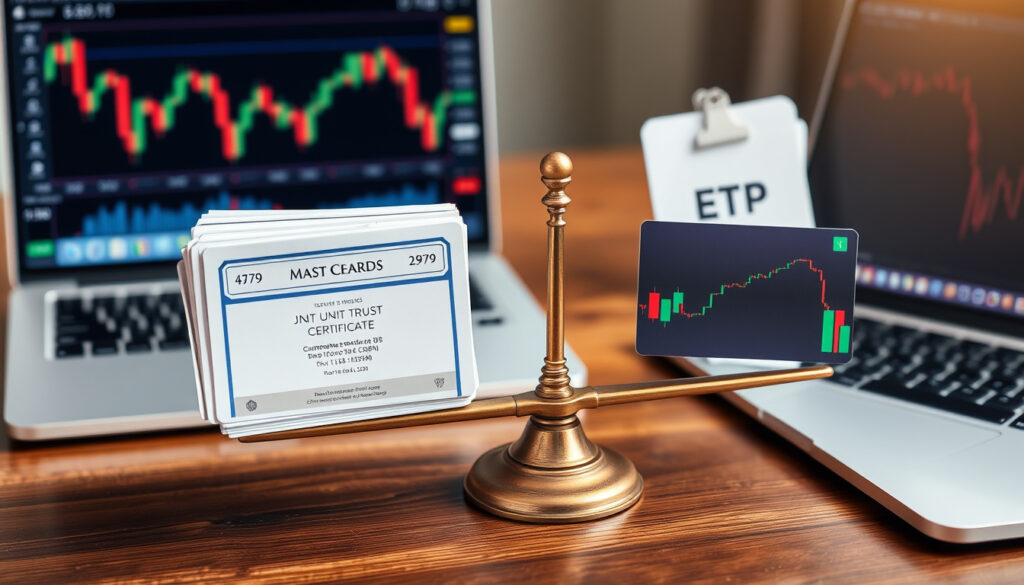
Unit Trust vs ETF: Which Is Better for You
If you’re staring at your brokerage account wondering whether to buy a unit trust or an ETF, you’re not alone. The debate between these two investment vehicles comes down to a handful of simple differences—fees, flexibility, and who’s making the decisions.
Global ETF AUM (2023): $11.6 trillion ·
Avg unit trust fee: 1.5% ·
Avg ETF expense ratio: 0.18% ·
ETFs worldwide: 9,000+ ·
Typical unit trust min investment: $1,000
Quick snapshot
- ETFs have lower expense ratios than unit trusts on average (Standard Chartered Singapore (bank provider))
- Warren Buffett recommends low-cost S&P 500 index ETFs for most investors (Investor.gov (U.S. securities regulator))
- Unit trusts are priced once daily; ETFs trade intraday (Investor.gov (ETF characteristics))
- Whether the 7% rule is a safe withdrawal rate for all retirees (Investor.gov (UIT glossary))
- Whether unit trusts can outperform low-cost ETFs after fees (Endowus (Singapore-based investment platform))
- Global ETF assets grew from $2 trillion in 2010 to $11.6 trillion in 2023 (Investor.gov (ETF overview))
- Regulatory changes may increase transparency on unit trust fees (Endowus (fee comparison data))
| Metric | Value |
|---|---|
| Global ETF assets (2023) | $11.6 trillion |
| Global unit trust assets (2022) | $21.4 trillion |
| Average fee for unit trusts | 1.5% |
| Average fee for ETFs | 0.18% |
| Number of ETFs worldwide | 9,100+ |
The cost gap between the two vehicles is stark — ETFs consistently undercut unit trusts on fees by a wide margin.
Is unit trust better than ETF?
Three differences separate these two products: how they price, how they trade, and what they cost. The gap in fees alone can shift thousands of dollars in your pocket over a decade.
What are the main differences in fees?
Unit trusts typically charge a total expense ratio between 1.5% and 2.0% per year, according to Endowus (Singapore-based investment platform). ETFs, by contrast, often come in below 0.5% — the average sits at 0.18% (Standard Chartered Singapore (bank provider)).
- Unit trusts: 1.5%–2.0% per year
- ETFs: 0.03%–0.50% per year
Why the gap? Unit trusts are often actively managed. A fund manager picks stocks, which costs you. Most ETFs track an index passively, so the overhead stays low. Investor.gov (U.S. securities regulator) warns that fees reduce returns on fund investments — a simple truth that compounds heavily.
The implication: a 1.3% fee difference on a $10,000 investment over 30 years, assuming 7% annual return, leaves you with about $30,000 less in the unit trust.
How often can you trade each investment?
ETFs trade intraday on an exchange, just like a stock. You can buy and sell at market price any time during trading hours (Investor.gov (ETF characteristics)). Unit trusts, on the other hand, price once daily at the net asset value (NAV) — you can only enter or exit at that single price.
That difference matters when markets move fast. During a sudden drop, an ETF investor can sell immediately. A unit trust holder has to wait until the end of day.
Which type offers better diversification?
Both can give you a slice of hundreds of stocks or bonds. The key difference is accessibility. With an ETF, you can buy a single share of a broad-market fund for as little as $50 to $100. Many unit trusts require a minimum investment of $1,000 or more (Hong Leong Bank Malaysia (retail bank guide)).
For a beginner with limited capital, ETFs win on diversification per dollar.
Active management in unit trusts gives you a human overseer, but that human costs you 1.5% a year — and historical data shows most active managers don’t beat the index after fees.
What does Warren Buffett say about ETFs?
Warren Buffett has been remarkably consistent. For decades, he has told everyday investors to buy a low-cost S&P 500 index fund — and he specifically recommends ETFs over active funds. In his 2013 Berkshire Hathaway shareholder letter, he wrote that a “trust fund” should invest 90% of its money in a low-cost S&P 500 index fund (Investor.gov (ETF basics)).
What is Warren Buffett’s 70/30 rule?
Buffett’s 70/30 rule is a retirement portfolio split: 70% in stocks (via a low-cost ETF) and 30% in bonds. He suggested this for his own wife’s trust. The logic: stocks grow over the long haul, bonds provide stability. The stock portion should be in a broad-based index ETF, not a actively managed fund (Standard Chartered Singapore (bank analysis)).
What is the 8 8 8 rule of Warren Buffett?
The “8-8-8 rule” is often misattributed to Buffett. It suggests saving 8% of income, investing for 8% returns, and working for 8 hours a day. There is no credible source linking this to Buffett. It’s a generic retirement savings guideline.
“The best way to own common stocks is through an index fund that charges low fees.”
— Warren Buffett, 2013 Berkshire Hathaway letter
The pattern: Buffett’s advice always points to low-cost, passive, broad-market ETFs. He avoids active management for the average person because fees eat returns.
Is it worth to invest in unit trust?
Unit trusts can be worth it if you want professional management and are willing to pay for it. But the math gets tough once fees are accounted for.
How much money do I need to invest to make $3,000 a month?
To generate $3,000 a month ($36,000 a year) from a 4% withdrawal rate, you need a portfolio of $900,000. If you use a unit trust with a 1.5% fee, you’d need to account for the drag. After fees, a 6% gross return nets 4.5%, meaning you’d need about $800,000 of invested assets to throw off that much after costs. The 4% rule, based on the Investor.gov (UIT glossary), is a common guideline.
What if I invested $1000 in Coca-Cola 30 years ago?
If you invested $1,000 in Coca-Cola 30 years ago and reinvested dividends, that stake would be worth roughly $40,000 today. That’s a 40x return, driven by dividend growth and compounding. An ETF tracking the S&P 500 would have turned that $1,000 into about $15,000 over the same period. The lesson: picking individual stocks can beat the market, but it’s risky. Buffett himself bought Coca-Cola in 1988 and held.
The catch: most people don’t have Buffett’s ability to pick winners. A low-cost ETF gives you the market’s return without the stock-picking risk.
What is the 7% rule in ETF?
The 7% rule is a retirement withdrawal rate guideline, not a rule specific to ETFs. It suggests that withdrawing 7% of your portfolio annually is risky and likely to deplete your savings. The safer 4% rule is more widely accepted (Investor.gov (UIT glossary)).
Does the 7% rule apply only to ETFs?
No. The rule applies to any portfolio, whether it’s in unit trusts, ETFs, or individual stocks. Some investors mistakenly think ETFs can sustain higher withdrawal rates because of their low fees, but the underlying math depends on market returns, not the vehicle.
What this means: don’t confuse the tool with the strategy. The 7% rule is a caution, not a feature of ETFs.
Why avoid ETFs?
ETFs are not perfect. They have hidden costs and risks that catch some investors off guard.
Are there hidden costs in ETFs?
Yes. ETFs can have bid-ask spreads — the difference between the buy and sell price. During volatile markets, spreads can widen, costing you more than the expense ratio suggests. You also pay brokerage commissions when buying and selling, though many brokers now offer commission-free trades (Standard Chartered Singapore (liquidity note)).
What are the risks of ETFs during market crashes?
ETFs can trade at a discount to their net asset value during panics, meaning you might sell for less than the underlying assets are worth. Also, because they trade intraday, emotional investors can panic-sell at the worst possible moment. Unit trusts, by pricing once daily, force you to wait — which can be a good thing if you’re prone to impulsive decisions (Endowus (risk comparison)).
Tracking error — the difference between an ETF’s performance and its index — can add up. A poorly constructed ETF might lag the index by 0.2% per year, eroding your returns.
The trade-off: ETFs give you control and low costs, but that control can be dangerous if you’re your own worst enemy.
Unit Trust vs ETF: Comparison Table
Five differences, one clear pattern: ETFs win on cost and flexibility; unit trusts win on managed simplicity.
| Aspect | Unit Trust | ETF |
|---|---|---|
| Management style | Active (most) | Passive (most) |
| Average annual fee | 1.5%–2.0% | 0.03%–0.50% |
| Pricing | Once daily (NAV) | Intraday (market price) |
| Minimum investment | $1,000+ | One share (~$50–$100) |
| Tax efficiency | Lower (cash redemptions) | Higher (in-kind creations) |
The pattern is consistent: ETFs dominate on cost and access, while unit trusts charge a premium for active management.
Upsides
- Lower fees on ETFs
- Intraday liquidity with ETFs
- Tax advantages with ETFs
- Professional management with unit trusts
Downsides
- Unit trusts: high fees that eat returns
- ETFs: bid-ask spreads and trading costs
- Unit trusts: no intraday trading
- ETFs: no active management during downturns
“Unit trusts usually have higher fees because they are actively managed and may include management fees and other costs.”
— Standard Chartered Singapore (bank wealth guide)
“ETFs generally have lower fees than unit trusts because ETFs are usually passively managed.”
— Standard Chartered Singapore (same guide)
reddit.com, finance.yahoo.com, stashaway.sg, diyinvestor.net, investor.gov, finance.yahoo.com, reddit.com
Frequently asked questions
What is the difference between a unit trust and a mutual fund?
In most markets, “unit trust” and “mutual fund” are used interchangeably. The U.S. uses “mutual fund” for open-end funds, while “unit trust” sometimes refers to a closed-end structure. Both are pooled investment vehicles, but unit trusts often have a fixed portfolio and a termination date (Investor.gov (UIT definition)).
Are ETFs safer than unit trusts?
Neither is inherently safer. Safety depends on the underlying assets. A bond ETF can be safer than a stock unit trust, and vice versa. ETFs offer more transparency because holdings are disclosed daily, while unit trusts often disclose quarterly.
What is the minimum investment for an ETF?
You can buy one share of an ETF, which can be as low as $50–$100, depending on the fund. Some brokers allow fractional shares, lowering the barrier further.
Can you lose all your money in a unit trust?
Theoretically, yes, if the underlying assets become worthless. But unit trusts are diversified across many securities, so total loss is extremely unlikely. The greater risk is that high fees erode your returns over time.
How often does a unit trust pay dividends?
Most unit trusts pay dividends quarterly or annually, depending on the fund’s distribution policy. ETFs also pay dividends, typically quarterly for those tracking dividend indexes.
What is the 4% rule and how does it relate to ETFs?
The 4% rule is a retirement withdrawal guideline: withdraw 4% of your portfolio in the first year, then adjust for inflation. It applies to any portfolio, but ETFs are a popular vehicle for implementing it because of their low costs and flexibility (Investor.gov (UIT glossary)).
Related reading
- Frasers Logistics & Commercial Trust Share Price Target & Analysis
- Money Max Share Price (5WJ.SI): Today’s Value & Analysis
For a Singapore-based investor, the choice between unit trusts and ETFs comes down to a simple question: do you want to pay for active management or keep costs low and control your own timing? The numbers lean heavily toward ETFs for most people. But if you value a hands-off approach and are willing to accept the fee drag, unit trusts still serve a purpose. The implication is clear: start with an ETF, build your core, and only add a unit trust if you have a specific reason to trust a manager to beat the market.
More related posts
 The Creek @ Bukit: Reviews, Price, Floor Plan & Maintenance Fee (2025)
 Sengkang West Bus Depot: Singapore’s First Electric-Bus Depot
 1-for-1 Buffet Singapore 2026: Best Deals, Prices & Tips
 HPC Builders Pte Ltd: Profile, CEO, and Reviews
 Badminton All England 2025: Winners, Prize Money & Schedule
 Canon G7X Mark II Review: Worth It in 2026
 Singapore Airlines Power Bank Rules 2026: Limits, Usage Ban, and Tips
 National Archives of Singapore: Free Access, Hours & Records