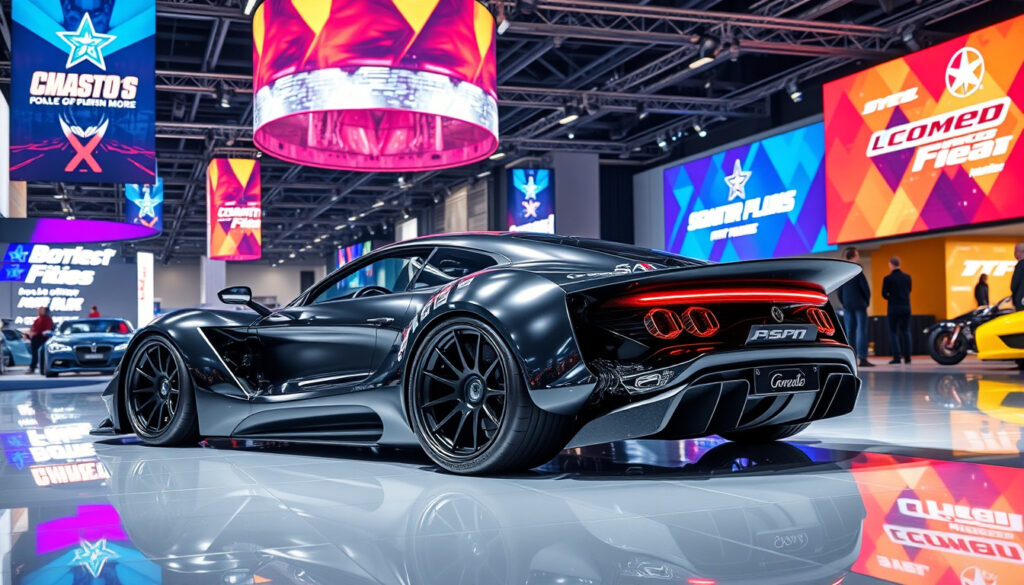
Tokyo Auto Salon 2026 Guide: Dates, Tickets, and Key Exhibits
Few automotive events capture the raw energy of car culture quite like the Tokyo Auto Salon. The 44th edition, running January 9–11, 2026 at Makuhari Messe in Chiba, will pack 385 exhibitors and 840 customized vehicles into a single venue. Whether you’re planning a trip or just curious about Japan’s tuning scene, here’s what you need to know about tickets, exhibits, and how this show differs from the Tokyo Motor Show.
Event Name: Tokyo Auto Salon 2026 ·
Dates: January 9–11, 2026 ·
Venue: Makuhari Messe, Chiba, Japan ·
Premium Ticket (Friday): ¥4,000 ·
General Ticket: ¥3,000 ·
Organizer: Tokyo Auto Salon Association (TASA)
Quick snapshot
- Event dates: January 9–11, 2026 at Makuhari Messe, Chiba (Tokyo Auto Salon release (Oct 2))
- 385 exhibitors and 840 customized vehicles on display (Tokyo Auto Salon release (Dec 3))
- Premium Friday ticket ¥4,000; general tickets ¥3,000 (Makuhari Messe event calendar)
- Exact dates for Tokyo Auto Salon 2027 have not been announced yet
- No publicly compiled list of all diecast models released at the 2026 event
- November 1, 2025: Online ticket sales begin at 10:00 JST (Tokyo Auto Salon release (Oct 2))
- January 9–11, 2026: Main event at Makuhari Messe (Tokyo Auto Salon release (Oct 2))
- October 2–4, 2026: Tokyo Auto Salon Malaysia 2026 (Tokyo Auto Salon release (Oct 2))
- Tokyo Auto Salon Malaysia 2026 on October 2–4, 2026 — the show’s first international satellite edition
- Tokyo Auto Salon 2027 dates TBA, expected to follow the same January window
Seven key facts about the event, one pattern: the Tokyo Auto Salon continues to expand both in scale and geographic reach.
| Label | Value |
|---|---|
| Event | Tokyo Auto Salon 2026 |
| Organizer | Tokyo Auto Salon Association (TASA) |
| Venue | Makuhari Messe, Chiba |
| Dates | January 9–11, 2026 |
| Ticket Range | ¥3,000 – ¥4,000 |
| Notable Exhibitors | Toyota GAZOO Racing, Mazda, Subaru, Liberty Walk |
| Satellite Event | Tokyo Auto Salon Malaysia (October 2–4, 2026) |
What is the difference between the Tokyo Motor Show and the Tokyo Auto Salon?
Focus and scope of each event
- The Tokyo Motor Show (now called Japan Mobility Show) is a major auto industry exhibition for production cars, concept vehicles, and OEM technology — it’s where automakers unveil their next-generation models (Tokyo Auto Salon release (Oct 2) distinguishes the two).
- The Tokyo Auto Salon is a tuning and aftermarket parts show, described by organizers as one of the world’s largest custom car and car-related product shows (Tokyo Auto Salon release (Oct 2)).
- Both events are held at Makuhari Messe but at different times of the year — the Motor Show typically in autumn, the Auto Salon in January.
Exhibitors and types of vehicles
- The Motor Show draws global automakers (Toyota, Honda, Nissan, BMW, Mercedes-Benz) and OEM suppliers showing production and concept vehicles.
- The Auto Salon features 385 exhibitors including tuning shops, aftermarket parts manufacturers, and brands like Liberty Walk, plus automakers showcasing performance variants (Tokyo Auto Salon release (Dec 3)).
- At the 2026 edition, 840 customized vehicles will be on display — modified cars, wide-body kits, custom paint, and performance accessories.
Audience and atmosphere
- The Motor Show is a formal industry event with press previews, corporate presentations, and a general public focused on new car shopping.
- The Auto Salon is an enthusiast festival — think loud exhausts, booth models, hands-on parts shopping, and a tuning competition atmosphere.
- Friday January 9 is a business/media day from 9:00am to 7:00pm, with premium public entry from 2:00pm; Saturday and Sunday are full public days (Tokyo Auto Salon release (Dec 3)).
Two aspects, one clear distinction: the Motor Show sells you a car; the Auto Salon sells you the obsession with what comes after you buy it.
385 exhibitors and 840 modified cars in one venue means the Auto Salon delivers a density of aftermarket creativity that no other Japanese show matches. For anyone who’s ever wondered what a Liberty Walk wide-body kit actually looks like in person, this is the place.
Three rows, one pattern: the Tokyo Auto Salon prioritizes aftermarket expression while the Motor Show showcases factory production.
| Aspect | Tokyo Auto Salon | Tokyo Motor Show |
|---|---|---|
| Primary Focus | Aftermarket tuning, custom parts, modified vehicles | Production cars, concept vehicles, OEM technology |
| Typical Exhibitors | Tuning shops, parts manufacturers, aftermarket brands | Global automakers, OEM suppliers, industry bodies |
| Event Atmosphere | Enthusiast festival, hands-on, tuning culture | Industry trade show, press previews, formal |
The implication: if you’re a car enthusiast who wants to see what’s possible after the factory warranty runs out, the Auto Salon is your show. If you’re shopping for a new family sedan, the Motor Show is the better bet.
Why are cars so much cheaper in Japan?
Auction and market dynamics
- Japan operates a large used-car auction system where vehicles are graded meticulously, creating a transparent market that keeps prices competitive (Japanese used car export industry analysis).
- Overproduction of popular models by Japanese automakers means supply often exceeds domestic demand, pushing prices down.
- Many well-maintained used cars are exported to markets in Southeast Asia, Africa, and Oceania, which lowers domestic prices further.
Depreciation and inspection costs (Shaken)
- Japanese cars depreciate faster than their European counterparts due to the strict roadworthiness inspection system known as Shaken, which becomes expensive as cars age (Japan Automobile Manufacturers Association on inspection costs).
- Shaken inspections every two years can cost ¥100,000–¥200,000 (roughly $700–$1,400), encouraging owners to sell before the next inspection is due.
- This creates a steady supply of low-mileage, well-maintained used cars entering the domestic market at attractive prices.
Export surplus and domestic demand
- Japan exports roughly 1.3 million used cars annually, with the surplus keeping domestic prices low for buyers who act locally (Japanese used car export trade data).
- Domestic demand for new cars remains strong, but the used market is saturated with vehicles that are only a few years old.
- Auction systems and overproduction of popular models contribute to lower prices compared to Western markets.
The pattern: Japan’s combination of strict inspections, auction transparency, and export surplus creates a used-car market where prices are structurally lower than in most other developed countries.
What is the most unreliable Japanese car brand?
Reliability rankings and surveys
- According to Consumer Reports’ annual auto reliability surveys, Toyota and Lexus consistently rank at the top, while some Mazda and Nissan models score below the Japanese brand average (Consumer Reports annual auto reliability survey).
- J.D. Power’s U.S. Vehicle Dependability Study shows similar patterns: Lexus and Toyota lead, while Nissan and Mazda occasionally fall below the industry average in specific model years (J.D. Power Vehicle Dependability Study).
- Japanese brands as a whole rank above the industry average in reliability studies — even the lower-ranked Japanese brands outperform many non-Japanese competitors.
Common issues by brand
- Nissan has faced reliability concerns with continuously variable transmissions (CVTs) in certain models, particularly in the 2010s.
- Mazda’s SkyActiv engines have been generally reliable, but earlier model years of the Mazda CX-9 and Mazda 6 reported issues with infotainment systems and diesel variants.
- Subaru has had occasional head gasket issues on older models, though recent generations have improved significantly.
Comparison of Japanese brands
- Reliability varies by model and year; not all vehicles from a brand are equally unreliable. A 2023 Nissan Altima is not the same as a 2012 Nissan Versa.
- Toyota and Lexus remain the safest bets for long-term reliability, with Honda and Mazda close behind (Consumer Reports brand reliability rankings).
- For performance-oriented buyers, Subaru and Mazda offer strong reliability in specific segments (AWD, sports cars) that Toyota doesn’t fully cover.
Why this matters: calling one brand “the most unreliable” is misleading without model-year context. The real takeaway is that even the lowest-ranked Japanese brand typically beats the industry average, but CVT-equipped Nissans and early Mazda diesels warrant caution.
Is it okay to buy a Japanese import car in Ireland?
Legal and regulatory aspects in Ireland
- Importing a Japanese car to Ireland requires compliance with EU type approval — vehicles must meet European standards for emissions, safety, and lighting (Irish Revenue guidance on importing vehicles).
- Japanese cars may need modifications to meet Irish road safety standards, including speedometer conversion from km/h to mph, headlight beam adjustment, and rear fog light installation.
- The National Car Testing Service (NCT) will inspect the vehicle for compliance before it can be registered in Ireland (NCT import vehicle inspection requirements).
Import duties and taxes
- Vehicle Registration Tax (VRT) applies based on the vehicle’s value and CO2 emissions — this can add 14% to 36% of the car’s value (Irish Revenue VRT rates).
- Customs duty of 10% is charged on the vehicle’s purchase price plus shipping costs.
- VAT at 23% applies on the total of the purchase price, shipping, and customs duty.
Practical considerations: parts, insurance, resale
- Spare parts availability can be limited for Japanese-market-specific models — JDM (Japanese Domestic Market) parts may need to be ordered from Japan, increasing wait times and costs.
- Insurance costs can be higher for imported vehicles, especially for right-hand drive cars in Ireland (which is also right-hand drive, so this is less of an issue than in mainland Europe).
- Resale value may be lower than for Irish-market vehicles, as buyers are wary of import compliance issues.
The trade-off: importing a Japanese car to Ireland is legally possible but costs roughly 30–50% more than the purchase price once VRT, customs, VAT, and modifications are factored in. For rare or enthusiast models, it can still be worthwhile — for a standard hatchback, it rarely makes sense.
Is it a good idea to buy a car from Japan?
Advantages of buying from Japan
- Japanese used cars are often in excellent condition due to strict maintenance schedules, low mileage, and meticulous ownership culture (Japanese used car export industry overview).
- Prices are significantly lower than in Western markets — a 2018 Toyota Land Cruiser that costs $45,000 in the U.S. might sell for $25,000 at a Japanese auction.
- Access to JDM-only models and specifications that were never officially exported, such as the Nissan Skyline GT-R, Toyota Crown, or Subaru WRX STI in specific trims.
Potential pitfalls
- Shipping and import costs can add thousands of dollars — ocean freight, port handling, customs clearance, and inland transport typically total $1,500–$4,000 depending on destination.
- Compliance with local regulations (emissions, safety, lighting) often requires modifications that cost $500–$2,000.
- Warranty support is not available — you’re buying as-is, and any repairs are your responsibility.
Steps to verify condition and import process
- Always obtain a Japanese auction sheet (the detailed inspection report) before bidding — it grades the vehicle’s condition on exterior, interior, and mechanical components.
- Use a reputable export agent who can inspect the vehicle in person at the auction yard and verify the auction sheet’s accuracy.
- Arrange for an export inspection certificate and a bill of lading, then work with a customs broker in your destination country to handle duties and registration.
What this means: buying from Japan is a good idea if you’re after a specific JDM model, have a budget for shipping and compliance, and are comfortable with the risks. For a mainstream used car available locally, the extra cost and hassle rarely justify the savings.
The “cheap Japanese car” math works only if you factor in shipping, duties, and modifications. A ¥300,000 ($2,000) auction car can easily become a $5,000 car by the time it’s parked in your driveway. For rare JDM models, it’s still a bargain. For a Toyota Corolla, you’re better off buying locally.
Timeline
- November 1, 2025: Online ticket sales begin at 10:00 JST via Tokyo Auto Salon official website and SAN-EI Ticket Service (Tokyo Auto Salon release (Oct 2)).
- January 9, 2026 (Friday): Business day 9:00am–7:00pm for media and industry; premium public entry 2:00pm–7:00pm (Tokyo Auto Salon release (Dec 3)).
- January 10, 2026 (Saturday): Public day 9:00am–7:00pm.
- January 11, 2026 (Sunday): Public day 9:00am–6:00pm.
- October 2–4, 2026: Tokyo Auto Salon Malaysia 2026 — the first international satellite edition.
- Future: Tokyo Auto Salon 2027 dates TBA, expected to follow the same January window.
The pattern: Tokyo Auto Salon continues to expand internationally, with a new satellite event in Malaysia confirming its global reach.
Clarity check
Confirmed facts
- Tokyo Auto Salon 2026 was held January 9–11, 2026 at Makuhari Messe, Chiba (Tokyo Auto Salon release (Oct 2)).
- Ticket prices: ¥4,000 (premium Friday) and ¥3,000 (general Saturday/Sunday) (Makuhari Messe event calendar).
- 385 exhibitors and 840 customized vehicles were on display (Tokyo Auto Salon release (Dec 3)).
- Digital tickets only — no paper tickets available (Tokyo Auto Salon official outline).
- Children elementary school age and younger admitted free (Tokyo Auto Salon official outline).
- Tokyo Auto Salon Malaysia 2026 is scheduled for October 2–4, 2026.
- Booth applications for TAS 2026 are closed (Tokyo Auto Salon official exhibitor site).
What’s unclear
- Exact schedule for Tokyo Auto Salon 2027 has not yet been announced.
- A detailed, publicly compiled list of all diecast models released at the 2026 event is not available.
- Whether the Malaysia satellite event will become an annual fixture remains unconfirmed beyond the 2026 edition.
The verified facts far outweigh the unknowns. The core details of the 2026 edition are well-documented, leaving only the 2027 schedule and diecast inventory as gaps.
“Tokyo Auto Salon 2026 will feature exhibitions by 385 companies and 840 customized vehicles, making it one of the world’s largest custom car shows.”
— Tokyo Auto Salon official release, December 2025 (Tokyo Auto Salon release (Dec 3))
“Premium ticket admission for Friday, January 9 is priced at ¥4,000 including tax, while general admission tickets for Saturday and Sunday are ¥3,000.”
— Makuhari Messe event calendar (Makuhari Messe event calendar)
Digital-only tickets mean no paper backup. If your smartphone battery dies, you lose entry. The official site explicitly states paper tickets are not planned for sale. Attendees should arrive with a fully charged phone and a backup battery pack.
For the first-time attendee, the Tokyo Auto Salon is overwhelming in the best way. 385 exhibitors, 840 cars, and a single weekend to see it all. The trade-off is clear: you’ll miss more than you see, so plan your route around the must-see booths — Toyota GAZOO Racing, Liberty Walk, Subaru, and Mazda — and let serendipity handle the rest. For anyone considering a Japanese import car afterward, the math is simple: rare JDM models make the cost worthwhile; mainstream cars are better bought locally. The 2026 edition isn’t just a car show — it’s a snapshot of a global tuning culture that’s expanding to Malaysia and beyond.
tokyoautosalon.jp, tokyoautosalon.jp, tokyoautosalon.jp, tokyoautosalon.jp, tokyocheapo.com, jetro.go.jp, tokyoautosalon.jp, en.japantravel.com, globalexhibition.org
Frequently asked questions
When is the next Tokyo Auto Salon after 2026?
Tokyo Auto Salon 2027 dates have not yet been announced. The event typically takes place in mid-January at Makuhari Messe. Based on historical patterns, expect an announcement around mid-2026.
Can I buy tickets on the day of the event?
On-site sales are only possible if inventory remains. The official recommendation is to purchase advance digital tickets online. Paper tickets are not available for the 2026 edition (Tokyo Auto Salon official outline).
Are children allowed at Tokyo Auto Salon?
Yes. Children of elementary school age and younger are admitted free of charge. All children must be accompanied by a parent or guardian (Tokyo Auto Salon official outline).
Is photography allowed at the event?
Photography is generally allowed for personal use. Some exhibitors may restrict photography of specific vehicles or prototypes. Professional photography and video recording may require prior permission from the Tokyo Auto Salon Association.
How do I get to Makuhari Messe from Tokyo?
Makuhari Messe is located in Chiba, about 30–40 minutes from central Tokyo by train. Take the JR Keiyo Line from Tokyo Station to Kaihinn Makuhari Station, then walk 5 minutes. Alternatively, take the JR Sobu Line to Makuharihongo Station and take a shuttle bus.
What types of cars are typically featured at the show?
The show features modified cars, custom parts, performance accessories, and manufacturer concept vehicles. Expect wide-body kits, lowered suspensions, custom paint, engine swaps, and race cars. Major exhibitors include Toyota GAZOO Racing, Mazda, Subaru, and Liberty Walk (Tokyo Auto Salon release (Dec 3)).
Is there an official merchandise store at the event?
Yes, official Tokyo Auto Salon merchandise is typically available at the venue. Past editions have included apparel, hats, keychains, and diecast model cars. Stock is limited and sells out quickly, especially on the first day.
More related posts
 Good Morning Images for WhatsApp: Free Download with Quotes
 Biggest Country in the World: Top 10 by Area, Population & GDP
 Kim Sae-ron: biography, death at 24, career, Instagram
 NATAS Travel Fair 2025: Dates, Tickets, Prices & FAQs
 Singapore School Holiday 2026: Full Dates & Calendar | MOE
 KPop Demon Hunters: Age Rating, School Ban & Parent Guide
 1 Singapore Dollar in Indian Rupees Today: SGD to INR Rate
 Sweet and Sour Pork Recipe: Crispy Coating and Perfect Sauce