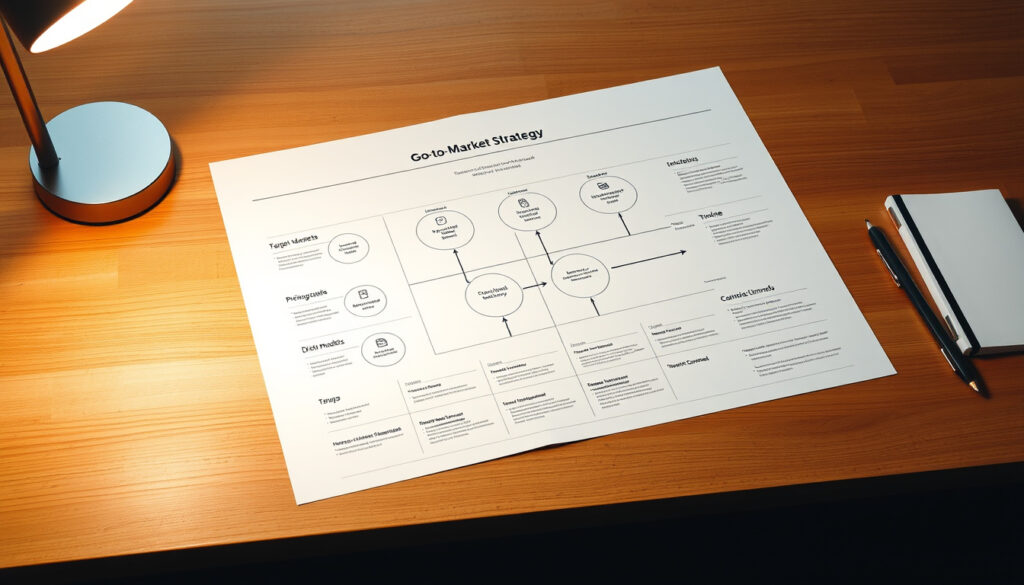
Go-to-Market Strategy – Components Framework and Steps
A go-to-market strategy serves as the bridge between product development and commercial success. Unlike broad business plans that cover multiple initiatives, a GTM strategy focuses narrowly on launching a single product or entering one specific market. The approach brings together marketing, sales, and operations teams to ensure the right customers receive the right message through the most effective channels.
Research from McKinsey reveals a stark reality: for every successful product launch, approximately four fail. These failures typically trace back to preventable mistakes—targeting the wrong customer segments, misjudging pricing models, or entering crowded markets without clear differentiation. Companies that invest time in developing a structured GTM strategy significantly improve their chances of reaching customers efficiently and achieving sustainable growth.
This guide examines the essential components of effective go-to-market strategies, the steps required to build one, and how organizations can adapt their approach based on whether they serve business customers or consumers directly.
What Is a Go-to-Market Strategy?
A focused plan for product launch success
Acquire customers efficiently
Research, Positioning, Execution
Time to revenue
At its core, a go-to-market strategy defines exactly how a company will launch a new product or expand into a new market. The strategy differs from a comprehensive business plan because it narrows its scope to address a single product launch or one specific market entry. This concentrated focus allows teams to allocate resources strategically and measure performance against clear, achievable targets.
Organizations that skip this planning phase risk several costly outcomes. They may chase audiences who never convert, enter markets too early or too late, or compete in saturated spaces where their offering fails to stand out. A well-crafted GTM strategy helps businesses avoid these pitfalls by establishing a clear roadmap from development to customer acquisition.
The most successful GTM strategies operate as living documents that evolve with market conditions. Initial plans provide direction, but ongoing measurement and adjustment ensure strategies remain relevant as customer preferences shift and competitive landscapes change. For those interested in dividend yields and analysis, similar principles apply when companies communicate financial performance to shareholders.
Key Insights on GTM Strategy
- Aligns product, sales, and marketing teams around shared customer acquisition goals
- Reduces launch risks by 30–50% according to industry benchmarks
- Focuses resources on defined target segments for faster return on investment
- Adaptable frameworks serve both startups and established enterprises
- Creates measurable checkpoints throughout the launch process
- Provides competitive differentiation in crowded markets
GTM Strategy Snapshot
| Element | Description | Example |
|---|---|---|
| Target Audience | Ideal customer profile | SaaS platforms targeting mid-market SMBs |
| Value Proposition | Unique selling points | AI-powered analytics reducing report time by 70% |
| Channels | Distribution methods | Direct sales combined with strategic partnerships |
| Metrics | KPIs to track | Customer acquisition cost, lifetime value, conversion rate |
What Are the Key Elements of a GTM Strategy?
Effective go-to-market strategies integrate multiple components that work together toward a common goal. Each element supports the others, creating a cohesive approach to reaching customers and driving adoption.
Core Components of Every GTM Strategy
Market analysis forms the foundation of any GTM strategy. This research examines customer needs, preferences, and pain points while evaluating competitive offerings. Without deep market understanding, organizations risk building products nobody wants or entering markets too crowded to penetrate.
Product design must align directly with identified customer needs. The strategy should articulate how the offering solves specific problems better than existing alternatives. This alignment ensures development resources focus on features that drive adoption rather than capabilities that fail to resonate with target audiences.
The value proposition explains precisely why customers should select your offering over competitors. This messaging goes beyond feature lists to communicate tangible outcomes—time saved, costs reduced, revenue increased. Strong value propositions address specific customer pain points and demonstrate measurable benefits.
Pricing strategy and distribution channels complete the commercial equation. Organizations must determine appropriate price points that reflect value while remaining competitive, then select distribution methods that reach target customers efficiently.
The GTM strategy works in conjunction with the product strategy. While product strategy defines what to build, GTM strategy determines how to reach customers with that product. Both frameworks must align for successful market entry.
Performance Measurement Framework
Sales and marketing execution plans translate strategy into action. These plans detail specific tactics, timelines, and responsibilities for reaching target customers. Customer journey mapping helps teams understand the decision-making process and identify opportunities to influence purchasing decisions.
Performance metrics and measurement frameworks enable continuous improvement. Teams should establish clear key performance indicators before launch, then monitor progress against benchmarks throughout the rollout. This data-driven approach allows for course corrections when initial strategies underperform expectations.
How Do You Create a Go-to-Market Strategy?
Building an effective GTM strategy requires a systematic approach that moves from understanding to execution. Organizations that skip foundational steps often face avoidable challenges later in the launch process.
The Three-Stage Framework
Consulting-derived GTM frameworks typically organize the approach into three main stages. The first stage, Analyse, involves deep research into the market landscape, competitive positioning, and customer segment characteristics. Teams must understand market size, growth trajectories, and the specific needs of target customers before proceeding.
The second stage, Positioning, defines how the offering will be perceived in the market. This involves crafting the value proposition, establishing messaging frameworks, and determining competitive differentiation. Effective positioning answers the fundamental question: why should customers choose this solution?
The third stage, Execute, transforms strategy into action. This phase includes implementing outbound sales initiatives, establishing B2B lead generation processes, and developing sales enablement materials. Execution requires measurable results and consistent market traction to validate the strategy’s effectiveness.
Eight Essential Steps
For B2B sales and market entry specifically, the process involves eight key steps that guide organizations from initial planning through measurable outcomes.
- Define target customer segments and develop detailed buyer personas that capture demographics, pain points, and decision-making criteria
- Analyze competitor pricing models, sales processes, and customer acquisition channels to identify market gaps and positioning opportunities
- Articulate the unique value proposition that differentiates your offering from alternatives in the market
- Communicate how the product drives measurable results, whether through time saved, productivity gained, or revenue increased
- Map the customer journey and decision-making process to understand touchpoints and influence opportunities
- Develop comprehensive sales and marketing execution plans that translate strategy into daily activities
- Establish pricing and distribution strategies that balance value capture with market accessibility
- Define success metrics and measurement frameworks that enable ongoing optimization
The U.S. B2B market presents particular challenges due to its competitive nature, with thousands of companies targeting similar customer segments across technology, finance, healthcare, and SaaS sectors. Clarity in messaging and precise targeting prove essential for standing out in this crowded landscape.
GTM Strategy Examples and Templates
Organizations benefit from structured templates that guide strategy development while ensuring comprehensive coverage of essential elements. A well-designed GTM template provides teams with clarity and speed, enabling faster execution and better alignment across stakeholders.
Essential Template Components
Effective GTM strategy templates include documented elements aligned across all teams involved in the launch. This documentation ensures everyone operates from the same understanding and reduces miscommunication during fast-paced execution phases.
A clear roadmap for all stakeholders outlines timelines, responsibilities, and dependencies. This roadmap serves as both a planning tool and a communication device, ensuring cross-functional teams understand how their work connects to broader launch objectives.
Understanding of GTM phases guides implementation by breaking the launch into manageable stages. Each phase includes specific deliverables, success criteria, and decision points that enable teams to assess progress and adjust course as needed.
Real-world examples adapted to specific contexts bring templates to life. Organizations should examine case studies from similar industries or customer segments to inform their own strategy development, adapting proven approaches to their unique circumstances.
A structured template provides startups with clarity and speed, allowing teams to communicate strategy effectively, test ideas faster, and align leadership around the same vision for market entry and growth. However, templates require customization—generic approaches rarely address specific market dynamics or competitive realities.
B2B vs B2C Go-to-Market Strategies
While B2B and B2C strategies share the fundamental goal of reaching customers effectively, they differ significantly in execution. Understanding these differences proves essential for allocating resources appropriately and crafting messages that resonate with target audiences.
| Aspect | B2B Approach | B2C Approach |
|---|---|---|
| Messaging Focus | Value, ROI, use cases, expertise, long-term outcomes | Consumer benefits, immediate gratification, lifestyle |
| Marketing Channels | Target specific roles or industries | Broad consumer audience channels |
| Sales Approach | Demos, consultations, pilots, procurement cycles | Direct purchase, marketing-driven conversion |
B2B messaging emphasizes value, return on investment, and measurable outcomes because business buyers operate under different decision-making frameworks than consumers. These buyers represent organizations accountable for their purchasing decisions and must justify expenditures to stakeholders.
B2C marketing focuses on consumer benefits and immediate gratification because individual purchasers make emotional decisions differently than committee-driven business buying processes. The sales cycle length, decision-makers involved, and evaluation criteria all differ substantially between these markets.
GTM Strategy vs Marketing Plan
An important distinction exists between a GTM strategy and a marketing plan. A GTM strategy encompasses the entire go-to-market approach, including sales, pricing, and distribution considerations. A marketing plan focuses specifically on marketing activities and campaigns without addressing the broader commercial execution required for successful market entry.
Organizations sometimes confuse these concepts, leading to incomplete launches that address marketing needs but fail to drive customer acquisition. The GTM strategy provides the strategic framework, while the marketing plan executes within that framework.
GTM Strategy Timeline and Phases
Developing and executing a comprehensive GTM strategy requires realistic timelines that account for research, planning, and iteration. Organizations that rush through phases often face costly adjustments later.
- Phase 1: Market Research (Weeks 1–4) — Conduct customer interviews, analyze competitive landscape, identify market size and growth patterns
- Phase 2: Strategy Development (Weeks 5–8) — Define positioning, craft value proposition, establish metrics and success criteria
- Phase 3: Launch Execution (Weeks 9–12) — Activate sales and marketing initiatives, begin customer outreach, monitor early performance indicators
- Phase 4: Optimization (Ongoing) — Analyze results, refine approach based on data, adjust messaging and channel allocation
The timeline varies based on market complexity and organizational readiness. Startups with existing market knowledge may compress research phases, while enterprises entering new markets may require extended analysis periods.
What Is Established vs Unclear in GTM Strategy
Understanding the boundaries between established best practices and variable elements helps organizations apply GTM frameworks appropriately. Some aspects of go-to-market strategy remain universally consistent, while others require context-specific adaptation.
- Core components universally accepted across industries: targeting, positioning, channel selection
- Frameworks validated by leading consulting firms including McKinsey and Bain
- Value proposition development follows consistent principles regardless of market
- Performance measurement through metrics like CAC, LTV, and conversion rate
- Industry-specific adaptations required for healthcare, finance, technology, and other sectors
- Metrics emphasis varies between B2B and B2C contexts
- Timeline requirements differ based on product complexity and regulatory considerations
- Channel effectiveness shifts based on audience preferences and market dynamics
The Evolution of Go-to-Market Strategies
Go-to-market strategies have evolved significantly from traditional marketing approaches. The shift from outbound-heavy tactics toward customer-centric models reflects broader changes in how buyers gather information and make purchasing decisions.
Product-led growth models have emerged as important alternatives to traditional sales-driven approaches, particularly in technology sectors. These models prioritize product experience as the primary driver of customer acquisition, with marketing and sales playing supporting roles.
Digital channels have transformed both B2B and B2C go-to-market execution. The proliferation of online touchpoints has created opportunities for precise targeting while simultaneously increasing competition for buyer attention.
2024 GTM Trends
Recent developments have accelerated technology adoption in GTM execution. Predictive analytics enable more precise targeting, while AI agents assist with repetitive sales and marketing tasks. The integration of conversational AI platforms has created new opportunities for automated customer engagement at scale.
GTM is the bridge between product and profit. Without a clear strategy connecting development to customer acquisition, even the most innovative products struggle to achieve commercial success.
Summary
A go-to-market strategy provides the structured approach organizations need to launch products successfully and enter new markets with confidence. The framework integrates market analysis, positioning, and execution into a cohesive plan that aligns teams and resources toward shared objectives. Whether serving business customers or consumers directly, organizations that invest in comprehensive GTM planning significantly improve their probability of achieving commercial outcomes. The strategy transforms from planning document to competitive advantage when teams commit to following established frameworks while adapting approaches to their specific market context.
For those exploring related topics, dividend yields and analysis provides insight into how companies communicate financial performance to shareholders, while share price analysis offers context on how market participants evaluate corporate value.
Frequently Asked Questions
What are GTM strategy frameworks?
GTM strategy frameworks provide structured approaches for planning market entry. The most common includes three stages: Analyse (understanding market and competition), Positioning (defining value proposition), and Execute (implementing sales and marketing initiatives). These frameworks help organizations systematically address key elements from target audience definition through performance measurement.
What are common mistakes in GTM strategies?
Common failures include targeting the wrong customer segments, misjudging pricing models, entering saturated markets without clear differentiation, and failing to align sales and marketing teams. Without proper planning, companies risk chasing the wrong audience or entering markets at suboptimal timing.
Who is responsible for GTM strategy?
Typically, senior leadership sponsors the GTM strategy while cross-functional teams execute it. Marketing leaders often coordinate strategy development, with sales teams providing customer insights and product teams ensuring offering-market fit. Success requires alignment across all three functions.
How long does it take to develop a GTM strategy?
Developing a comprehensive GTM strategy typically requires 4–8 weeks for research and planning, followed by ongoing execution and optimization. Compressed timelines work for organizations with existing market knowledge, while new market entries may require extended research phases.
What are best practices for startup GTM strategy?
Startups should focus on deep market analysis to understand customer needs, precise target segment definition to concentrate limited resources, clear value proposition development to differentiate from competitors, and establishing measurable success metrics from the beginning. Structured templates provide clarity and enable faster execution for resource-constrained teams.
How do B2B and B2C GTM strategies differ?
B2B strategies emphasize value, ROI, and use cases with targeting focused on specific roles or industries through consultation-based sales. B2C strategies prioritize consumer benefits and immediate gratification with broad audience marketing and direct purchase conversion. Sales cycle length, decision-makers involved, and evaluation criteria all differ substantially between these contexts.
What role does technology play in modern GTM execution?
Technology has become central to GTM execution through predictive analytics for customer targeting, AI agents for automated engagement, and digital platforms for scalable marketing outreach. Organizations adopting these tools gain competitive advantages through improved efficiency and more precise customer reach.
More related posts
 Star Awards 2025 Voting: Schedule, Results & 2026 Guide
 Tha Siam Authentic Thai Kitchen Parklane: Menu, Review & Di he
 Free VPN for iPhone: Which Ones Are Actually Safe in 2026
 Scoot 787-9 Seat Map: Best Seats, Configuration & Tips
 Best Time to Visit Hong Kong: Month-by-Month Guide
 Tokyo Auto Salon 2026 Guide: Dates, Tickets, and Key Exhibits
 CDAC School E-Vouchers: Clarifying What’s Actually Available
 When Was the Declaration of Independence Signed? The Real Date