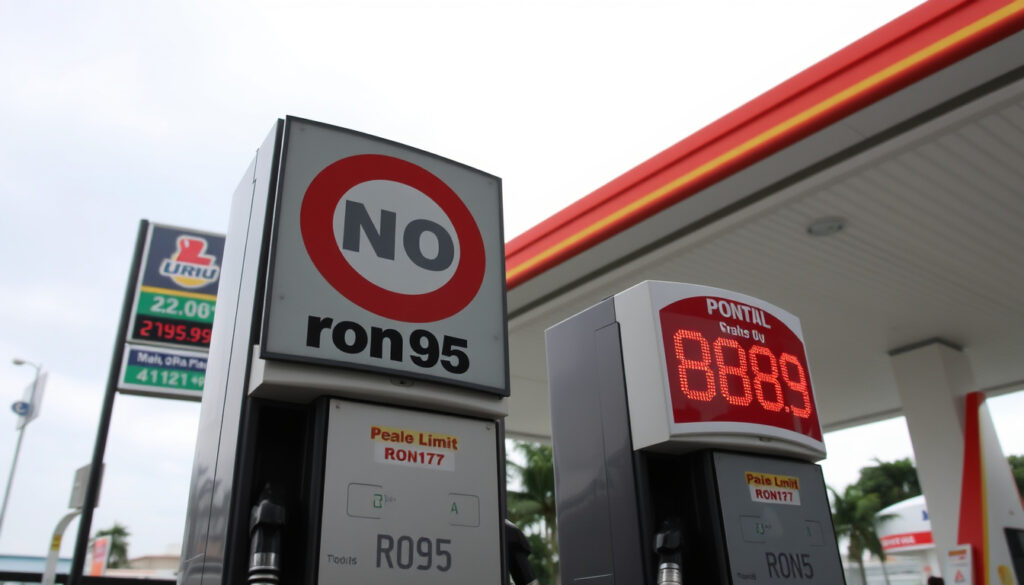
New Malaysia Petrol Rules April 1: RON95 Quota and Ban
There’s a particular ritual every Malaysian driver knows: the glance at the fuel gauge, the quick mental math on the ringgit, the decision between RON95 and something pricier — and that arithmetic changes on April 1, 2026, when BUDI95 recipients see their monthly subsidised RON95 quota cut from 300 litres to 200 litres and foreign-registered vehicles lose the right to buy RON95 altogether, as reported by Malay Mail (Malaysian news outlet). Here’s what the new rules actually say, what they leave open, and who has to change behaviour at the pump.
Rules effective: April 1, 2026 ·
New BUDI95 monthly cap: 200 litres ·
Previous BUDI95 monthly cap: 300 litres ·
Foreign-registered vehicles and RON95: Banned from April 1 ·
Required pump grade for foreign plates: RON97 ·
Fine for invalid pump closure: RM300,000–RM1,000,000 (Malay Mail)
Quick snapshot
- April 1, 2026: the RON95 ban on foreign-registered vehicles takes effect, covering both drivers and owners (Malay Mail (Malaysian news outlet)).
- BUDI95 monthly quota drops from 300 to 200 litres, a change reported by Malay Mail (Malaysian news outlet).
- Foreign-registered vehicles must refuel with RON97 (The Straits Times (regional newspaper)).
- Whether the 200-litre cap is counted per calendar month or as a rolling window.
- How fuel stations will verify a vehicle’s eligibility at the pump.
- Which agency will publish the official enforcement checklist.
- Whether any general RON95 pump price adjustment follows the quota change.
- Before April 1, 2026: the BUDI95 allocation is up to 300 litres per person per month (Malaysia Ministry of Finance (government portal)).
- March 26, 2026: Malay Mail (Malaysian news outlet) reports the ban will be enforced from April 1. (Malaysia Ministry of Finance (government portal))
- April 1, 2026: the ban and the 200-litre cap are in force (Malay Mail (Malaysian news outlet); The Straits Times (regional newspaper)). (Malaysia Ministry of Finance (government portal))
- BUDI95 recipients must keep monthly purchases within the 200-litre cap (Malay Mail (Malaysian news outlet)).
- Foreign-plate drivers must switch to RON97 and treat RON95 as unavailable (The Straits Times (regional newspaper)).
- Fuel stations face fines from RM300,000 to RM1,000,000 for closing pumps without valid reasons (Malay Mail (Malaysian news outlet)).
- Watch for official guidance on cap counting and pump verification.
Six figures carry the whole change: the date, the quotas, the fuel swap, and the penalty.
| Item | Detail |
|---|---|
| Effective date | April 1, 2026 |
| BUDI95 monthly cap | 200 litres |
| Previous quota | 300 litres (Malaysia Ministry of Finance (government portal)) |
| Foreign-registered vehicle RON95 purchase | Not allowed |
| Alternative fuel for foreign-registered vehicles | RON97 |
| Penalty range for fuel pumps closed without valid reason | RM300,000 to RM1,000,000 |
What is the current petrol subsidy scheme in Malaysia?
Malaysia’s current scheme works like a monthly fuel coupon: eligible Malaysians buy RON95 at a subsidised price, and the government covers the difference. The mechanism is called BUDI95, and the April 1 update changed how much of that coupon each person can spend each month.
Who is eligible for BUDI95
- BUDI95 is a targeted RON95 subsidy intended for Malaysians, and the allocation belongs to the person, not the vehicle — owning several cars does not increase it (BUDI95 official FAQ (government source)).
How BUDI95 rations subsidised RON95
- Eligible recipients pay RM1.99 per litre, and each purchase deducts from the remaining monthly balance, which renews at the start of each month (BUDI95 official FAQ (government source)).
- The BUDI95 FAQ also allows more than one purchase per day, with each transaction drawing from the same balance.
- So the cap is a recurring monthly limit, not a one-time allowance.
What changed in the April 1 update
- The monthly quota drops from 300 litres to 200 litres — a reduction Malay Mail reports is temporary until global supply conditions stabilise.
- The RM1.99 subsidised price remains in place; the government adjusted volume, not price.
- Foreign-registered vehicles are outside the subsidised RON95 scheme from April 1 and must refuel with RON97 (The Straits Times (regional newspaper)).
The 200-litre cap turns an open-ended subsidy into a ration. For a daily commuter, the monthly ceiling is now a budgeting problem, not just a discount at the pump.
The read: Malaysia is keeping the price and tightening the volume. The subsidy still exists — it just now has a ceiling.
Is RON 95 the same as 95 octane?
The name is the definition. RON95 is a petrol with a 95 octane rating, and the label is the fuel-grade name used on Malaysian pumps.
What RON means in petrol
- RON stands for the octane rating — a measure of how much compression the fuel can handle before it knocks. The higher the number, the more knock resistance.
- In Malaysia, the subsidised pump grade is RON95, the 95-octane petrol that gives the BUDI95 programme its name (BUDI95 official FAQ (government source)).
Why RON95 is a common fuel for petrol cars
- RON95 suits most modern petrol engines, which is why it became the mainstream grade at the centre of Malaysia’s subsidy system.
- RON97 is the higher-octane alternative that foreign-registered vehicles must switch to from April 1 (The Straits Times (regional newspaper)).
The distinction: this is about engine tolerance, not fuel quality. A higher octane number does not mean cleaner or more powerful fuel — it means the fuel can withstand more compression before igniting.
What is the price of RON 95 petrol in Malaysia today?
For BUDI95 recipients, the price is unchanged: RM1.99 per litre. For foreign-registered vehicles, the question is now moot — RON95 sits behind the ban, and RON97 is the applicable grade.
What the subsidised price does NOT cover for foreign-plate vehicles
- The rule follows the registration plate, not the driver’s nationality: foreign-registered vehicles cannot buy RON95 from April 1, while foreigners using Malaysian-registered vehicles are still allowed to buy it at the unsubsidised price (The Straits Times (regional newspaper)).
- In other words, the ban applies to the car, not the person behind the wheel.
A Malaysian citizen driving a foreign-registered vehicle is as restricted as a tourist, while a foreigner driving a Malaysian-registered car can still buy RON95. The plate decides, and no amount of paperwork changes that at the pump.
Why the price question is separate from the quota question
- The rule-change announcements did not include a new general pump price for RON95.
- The quota change limits how many litres a BUDI95 recipient can buy at RM1.99 — it does not change what the litre costs.
- The same April 1 update came as unsubsidised diesel crossed RM6 per litre, a signal that fuel costs are pressing on the subsidy budget (Malay Mail (Malaysian news outlet)).
The distinction: price and volume are different levers. Malaysia pulled the volume lever and left the headline price alone for eligible citizens.
Why is petrol in Malaysia so cheap?
The short answer is that the government pays part of the bill. Petrol in Malaysia is cheaper for eligible citizens because RON95 is subsidised through the BUDI95 programme (Malaysia Ministry of Finance (government portal)).
Government subsidy and price control
- BUDI95 is the targeted delivery mechanism: eligible Malaysians get the discounted price while the broader market pays pump prices set under the control system (BUDI95 official FAQ (government source)).
- Foreign-registered vehicles fall outside that subsidy — which is exactly why the April 1 rule pushes them to RON97 (The Straits Times (regional newspaper)).
How the BUDI95 cap reduces subsidy exposure
- The monthly cap dropped from 300 litres to 200 litres per person (Malay Mail (Malaysian news outlet)).
- Because the allocation is per individual, the cap limits how much subsidised volume the state funds each month — even in households with multiple vehicles (BUDI95 official FAQ (government source)).
What the quota cut means for pump prices
- The subsidised price stays at RM1.99 per litre (Malay Mail (Malaysian news outlet)).
- The reduction is temporary, running until global supply conditions stabilise (Malay Mail (Malaysian news outlet)).
Fuel stations now operate under a stricter enforcement regime, with fines of RM300,000 to RM1,000,000 for closing pumps without valid reasons. The official checklist on what counts as valid is the detail worth watching.
The trade-off: Malaysia chose to keep cheap fuel visible at the pump and shrink the amount each person can buy. That protects the headline price while trimming the government’s subsidy exposure.
Which country does Malaysia buy petrol from?
The honest answer from the rule-change record: the April 1 announcements do not name a supplier country. They are about who buys which grade, not where the barrels come from.
Malaysia’s domestic refining and import position
- The sources behind the April 1 enforcement coverage do not identify a single country as Malaysia’s petrol supplier.
- Tracing import sources properly requires official trade and energy statistics, which sit outside the enforcement notices reviewed here.
Why supply-source reporting needs official trade data
- Import and refining patterns shift with market conditions, so a reliable answer has to come from published trade records, not fuel-pump announcements.
- The April 1 rules change subsidy eligibility and pump access; they do not change where Malaysia sources its fuel.
The takeaway: the new rules tell you who can buy which fuel, not where the fuel comes from. Treat the two questions as separate.
Before and after: the April 1 changes
Three rows capture the whole shift: the quota shrinks, the price holds, and the plate decides the fuel.
| Rule | Before April 1, 2026 | From April 1, 2026 |
|---|---|---|
| BUDI95 monthly quota | Up to 300 litres per eligible person (Ministry of Finance) | 200 litres per eligible person (Malay Mail) |
| BUDI95 subsidised price | RM1.99 per litre (BUDI95 official FAQ) | RM1.99 per litre (Malay Mail) |
| RON95 for foreign-registered vehicles | No blanket ban in force | Banned; RON97 required (Malay Mail; The Straits Times) |
The pattern: Malaysia didn’t raise the pump price for its citizens; it shrank the volume and reassigned the fuel grade by plate.
Timeline: how the April 1 rules came together
- Before April 1, 2026: the BUDI95 allocation is up to 300 litres per person per month (Ministry of Finance).
- March 26, 2026: Malay Mail reports the RON95 ban on foreign-registered vehicles will take effect on April 1 as part of tighter fuel-subsidy controls.
- March 31, 2026: BusinessToday also covers the foreign-vehicle ban taking effect on April 1.
- April 1, 2026: the rules switch on — the 200-litre BUDI95 cap is in force, and foreign-registered vehicles must refuel with RON97 (Malay Mail; The Straits Times).
The signal: the change was announced and enforced within a single week, leaving no transition window for pump operators or cross-border drivers.
What’s confirmed and what’s still unclear
Confirmed facts
- Foreign-registered vehicles are banned from buying RON95 from April 1, 2026 (Malay Mail).
- The ban covers both drivers and owners under the enforcement provisions (Malay Mail).
- Foreign-registered vehicles must use RON97 (The Straits Times).
- The BUDI95 monthly quota is 200 litres, down from 300 (Malay Mail).
What’s unclear
- Whether the 200-litre cap is counted per calendar month or as a rolling window.
- How fuel stations will verify a foreign-registered vehicle’s eligibility at the pump.
- Which government agency will publish the official enforcement checklist.
- Whether any general RON95 pump price adjustment follows the quota change.
The balance: the core rules are confirmed, but the operational details — verification, reset timing, enforcement guidance — are still open.
Key statements behind the rule change
From April 1, the purchase and sale of RON95 to foreign-registered vehicles is no longer allowed, as part of tighter fuel-subsidy controls.
— Malay Mail (Malaysian news outlet), reporting the enforcement announcement
It’s the vehicle plate, not the nationality — foreigners can still pump RON95.
— The Straits Times (regional newspaper)
Fuel subsidies are maintained, but the BUDI95 quota is reduced to 200 litres per month.
— Malay Mail, reporting the Finance Ministry’s April 1 statement
The through-line: the enforcement announcement and the Finance Ministry’s statement both frame this as subsidy control — the quota is the adjustment tool, and the plate is the eligibility test.
What the new rules mean
Put together, the April 1 changes are one policy move with two edges: a smaller monthly ration for BUDI95 recipients and a hard fuel swap for foreign-registered vehicles. The quota cut trims the government’s subsidy exposure without touching the RM1.99 headline price, and the RON95 ban removes foreign-registered vehicles from the subsidised-fuel equation entirely. For fuel station operators, the operational choice is now clear: keep RON95 flowing for eligible BUDI95 users, direct foreign-plate vehicles to RON97, and document any pump closure — because the penalty range of RM300,000 to RM1,000,000 turns an undocumented shutdown into a very expensive decision.
Frequently asked questions
Which vehicles are banned from buying RON95 from April 1, 2026?
Foreign-registered vehicles. The ban is based on the registration plate, not the driver’s nationality, and it covers both drivers and owners under the enforcement provisions (Malay Mail; The Straits Times). Foreigners driving Malaysian-registered vehicles are still allowed to buy RON95 at the unsubsidised price (The Straits Times).
How many litres of subsidised RON95 can eligible citizens buy each month after April 1?
200 litres through BUDI95, down from 300 litres (Malay Mail). The allocation belongs to the individual, not the vehicle, and each purchase deducts from the remaining monthly balance, which renews at the start of the month (BUDI95 official FAQ).
What was the BUDI95 monthly limit before April 1?
Up to 300 litres per person per month, the level in place when the programme launched (Malaysia Ministry of Finance).
What fuel should foreign-registered vehicles use in Malaysia?
RON97. From April 1, RON95 is not available to foreign-registered vehicles at any price, and RON97 is the required pump grade (Malay Mail; The Straits Times).
What fines can fuel pumps face if they close without a valid reason?
RM300,000 to RM1,000,000, under the enforcement framework announced with the tightened fuel-subsidy controls (Malay Mail).
The short version for drivers: foreign-plate vehicles run on RON97, and BUDI95 recipients count litres, not just ringgit.
More related posts
 Hooker Valley Track Closure: 2026 Reopening & Alternatives
 28 Inch Luggage Size: Dimensions, Weight & Airline Rules
 What is Passwordless Login? How It Works & Why More Secure
 Manchester United vs Arsenal: Head-to-Head Stats & History
 Traffic Jam Singapore Now: Live Traffic Cameras & Maps
 UOB One Bonus Interest: Earn Up to 5.65% p.a. Rates Guide
 Bao Shi Fu Singapore: Menu, Prices, Reviews & Outlets (2025)
 Money Changer Jurong Point: Best Rates, Hours & Tips