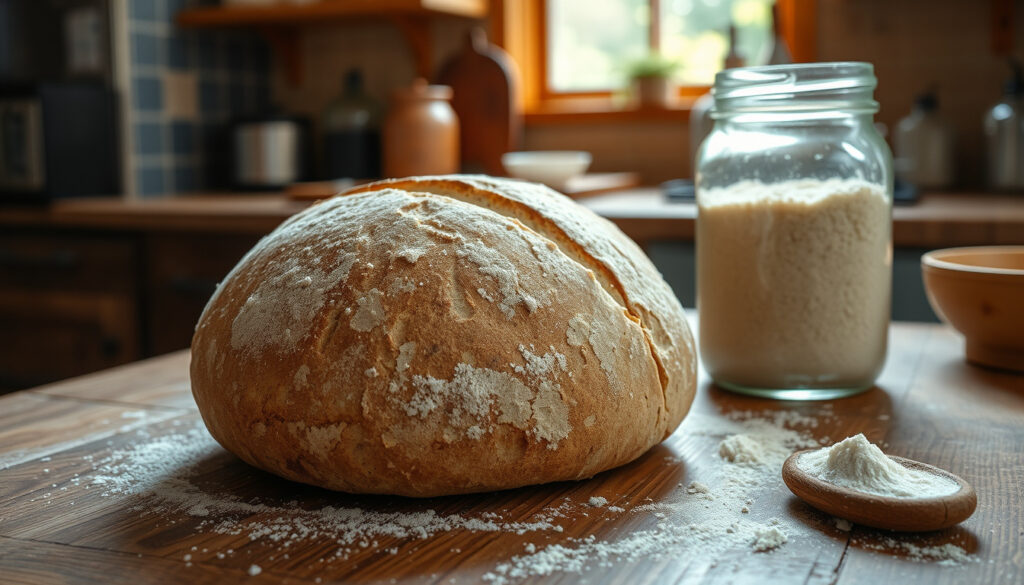
How to Make Sourdough Bread: Beginner Recipe & Tips
There’s a satisfying moment in every first-time sourdough baker’s week when a jar of flour and water starts to bubble — that’s the starter waking up, and a real loaf is within reach, and a basic sourdough bread needs just flour, water, salt, and an active starter, with most of the work handed off to time; the classic beginner rhythm is a two-day schedule that ends in a hot Dutch oven (The Perfect Loaf (baker-led sourdough guide)). This guide walks through that recipe and answers the follow-ups that actually matter: skipping the starter, digestibility, pizza, dinner ideas, and cost.
Typical total time: 24–48 hours including fermentation ·
Active preparation time: 20–30 minutes ·
Core ingredients: Flour, water, salt, sourdough starter ·
Oven temperature: 450°F–500°F / 230°C–260°C
Quick snapshot
- Sourdough starter can be made with only flour and water (The Clever Carrot (beginner sourdough blog)).
- Sourdough bread relies on wild yeast and lactic acid bacteria, not commercial yeast (Baker Bettie (baking education site)).
- Long fermentation creates the sour flavor and chewy crumb (NYT Cooking (New York Times food desk)).
- Whether sourdough is easier to digest depends on the individual.
- Exact fermentation times vary with temperature, flour, and starter strength.
- Sourdough pizza’s health advantage over regular pizza is not a fixed rule.
- Two-day workflow: mix on day one, cold proof overnight, bake on day two (The Perfect Loaf (baker-led sourdough guide)). (ChainBaker (baking science channel))
- Folds land roughly one hour apart during the bulk ferment (ChainBaker (baking science channel)).
- Baking day runs 30–45 minutes in a covered Dutch oven until deep golden brown (The Perfect Loaf (baker-led sourdough guide)). (ChainBaker (baking science channel))
- After the flour–water rest, stretch-and-folds build strength without a mixer (The Perfect Loaf (high-hydration sourdough guide)).
- Leftover starter can become pizza dough, savory pancakes, or crackers. (The Perfect Loaf (high-hydration sourdough guide))
- A chilled, proofed dough that springs back slowly from a poke is ready for the oven. (The Perfect Loaf (high-hydration sourdough guide))
Seven numbers, one pattern: sourdough rewards precision — the ratios and temperatures below are where most loaves are won or lost.
| Stage | Reference value |
|---|---|
| Starter feeding ratio | 1:1:1 starter:flour:water by weight (The Clever Carrot (beginner sourdough blog)) |
| Starter environment | ~70–82°F, loosely covered (University of Illinois Extension (public university food-safety resource)) |
| Autolyse | At least 30 minutes before adding salt (Baker Bettie (baking education site)) |
| Bulk fermentation | 4–12 hours at room temperature |
| Cold proof | 8–24 hours in the refrigerator |
| Bake temperature | 450°F–500°F / 230°C–260°C |
| Main dough formula | 700 g white bread flour, 300 g whole-grain flour, 750 g water, 200 g ripe starter (NYT Cooking (New York Times food desk)) |
Can you give me a beginner sourdough bread recipe?
Yes. A real beginner sourdough recipe is more about schedule than skill: active starter, flour, water, salt, a few folds, and an overnight stay in the fridge. The two-day pattern in the snapshots above is the one most beginner guides land on, and it keeps hands-on work to about 20–30 minutes.
The no-fail rule: bake by visual cues, not clock times. A bubbly, peaked starter and a puffy, jiggly dough are better signals than any timer.
The beginner formula
- 700 g white bread flour
- 300 g whole-grain flour
- 750 g water
- 200 g ripe starter
- 20 g fine sea salt (about 2% of the flour weight)
This is NYT Cooking’s beginner formula, shown in the key facts table above. Halve it for a first loaf if you don’t want two large boules.
Step by step: mix, fold, shape, bake
- No mixer required — stretch-and-folds do the gluten work.
- Work by weight, not volume; a kitchen scale makes the ratios repeatable.
- Every kitchen is different, so let the dough’s look and feel be your final judge.
- Day 1, evening — feed the starter. Use the 1:1:1 ratio from the key facts table (starter:flour:water) so it peaks when you’re ready to mix (The Clever Carrot (beginner sourdough blog)).
- Day 2, morning — mix and rest. Combine the flours and water, then let the dough rest at least 30 minutes before adding salt — this autolyse step softens the flour and starts gluten development.
- Add the starter, then fold. Mix in the ripe starter and salt, then perform 3–4 rounds of stretch-and-folds spaced about an hour apart, until the dough feels stronger and smoother (ChainBaker (baking science channel)).
- Bulk ferment. Leave the dough at room temperature for 4–12 hours; it should look puffy, show bubbles, and hold a gentle indentation.
- Shape. Turn the dough onto a lightly floured surface, tighten it into a round, and place it seam-side up in a floured proofing basket.
- Cold proof. Refrigerate for 8–24 hours; the cold slows fermentation and makes the dough easier to score and bake.
- Bake. Preheat a Dutch oven to 450°F–500°F (230°C–260°C), turn the dough onto parchment, score it, and bake covered for most of the bake, then uncovered until deep golden brown — 30–45 minutes total.
The two-day timeline at a glance
- Evening feedings build starter strength.
- Morning mixing means daytime bulk fermentation.
- Overnight cold proof means lunchtime baking.
Six checkpoints, one pattern: nearly all the labor lands on day one, and day three is mostly preheat and patience.
| Checkpoint | What happens |
|---|---|
| Day 1, evening | Feed the starter so it is active and bubbly. |
| Day 2, morning | Mix flour, water, and starter; rest for 30–60 minutes. |
| Day 2, midday | Add salt and do 3–4 sets of stretch and folds. |
| Day 2, afternoon | Shape the dough and place it in a proofing basket. |
| Day 2, night | Cold proof in the refrigerator for 8–24 hours. |
| Day 3 | Bake in a Dutch oven until deep golden brown. |
The implication: for a first loaf, judge success by process, not perfection — a bubbly starter, a puffy dough, and a crust that crackles as it cools are the wins that matter.
What are some recipes I can make with a sourdough starter?
- Pizza dough — the full walkthrough is below in the pizza section.
- Savory pancakes, crackers, and flatbreads made with leftover starter.
- Garlic bread, grilled sandwiches, croutons, and panzanella from the baked loaf.
Once the starter is healthy, it stops being a single-purpose ingredient. The same culture that raises a boule also lifts pizza crust, pancakes, and crackers — which is why keeping it alive stops feeling like a chore.
Can you give me an easy recipe for homemade bread?
- No-knead dough: stretch-and-folds replace elbow grease.
- Big flavor from a long, cold ferment.
- A Dutch oven gives bakery-style crust without special equipment.
The easiest honest answer is the recipe above. Active work totals about 20–30 minutes across two days; the rest is fermentation doing its job on your counter and in your fridge.
Can you make sourdough without a starter?
Not true sourdough. A starter is the living culture that defines the bread; without it, you get a fine yeasted loaf but none of the long fermentation that creates sourdough’s tang and open crumb.
What can I use if I don’t have a sourdough starter?
- Commercial yeast: instant yeast makes a fast rustic loaf, but the result is yeasted bread, not sourdough.
- A starter from a friend: a spoonful of active starter is enough to feed and multiply into your own supply.
- A no-starter sourdough trick: some recipes pair commercial yeast with an acidic ingredient, like yogurt or buttermilk, to mimic the tang — useful, though the keeping qualities differ.
How do I make a sourdough starter?
- Mix 50 g whole rye flour with 55 g unchlorinated water.
- Keep it loosely covered in a warm environment around 70–82°F.
- Feed once daily at first, then twice daily as activity increases.
- Use it when it’s bubbly, risen substantially, and near its peak or beginning to collapse.
This starter routine follows University of Illinois Extension guidance (public university food-safety resource); the final readiness check is visual, not a clock time.
The catch: you can bake bread without a starter, but you can’t bake sourdough without the fermentation a starter brings. Five days of feedings is the cheapest insurance you’ll ever buy — and it costs about 100 grams of flour.
Is sourdough easier to digest?
For some people, yes — but it’s individual. The fermentation changes the dough’s chemistry in ways that can make it gentler, yet sourdough is not a medical treatment, and people with gluten sensitivity should make decisions with their doctor.
What makes fermented dough different from regular bread?
- Fermentation breaks down some of the gluten and phytic acid found in flour.
- Sourdough bacteria produce organic acids during the long proof, which is what sharpens the flavor.
- Those organic acids and the extra fermentation are also why sourdough keeps longer than a typical commercial loaf.
The mechanism is real: Baker Bettie (baking education site) walks through how the fermentation stage changes the dough. The individual part is where the science stops being universal — some people notice a difference, others don’t. If you’re also reworking your diet for heart health, our guide on how to reduce cholesterol with a healthier diet puts fermented foods in a bigger context.
Confirmed facts
- Sourdough starter can be made with only flour and water.
- Sourdough bread relies on wild yeast and lactic acid bacteria.
- Long fermentation produces the sour flavor associated with sourdough.
What’s unclear
- Whether sourdough is easier to digest depends on the individual.
- Exact fermentation times vary with temperature, flour, and starter strength.
- Sourdough pizza’s health advantage over regular pizza is not a fixed rule.
Don’t turn sourdough into a health claim. Fermentation changes the chemistry of the loaf, but individual digestion still decides whether you feel a difference.
Why this matters: sourdough is not magic, but it is different — the fermentation does real chemical work, and whether you feel it depends on your own digestion.
Can I use sourdough for pizza?
Yes, and it’s one of the best uses of a healthy starter. Sourdough starter replaces commercial yeast in pizza dough, and the longer ferment brings a flavor that a same-day dough doesn’t have.
What flour is best for sourdough pizza?
- Bread flour gives the chewy structure pizza eaters expect.
- 00 flour produces a softer, crisper bite, especially in a home oven.
- A blend of the two is a common compromise for beginner pizzaioli.
There’s no single correct answer; the best flour is the one you can find and use consistently. Hydration matters more — a wetter dough stretches thinner and bakes with more oven spring.
What is a quick recipe for sourdough pizza crust?
- Mix flour, water, salt, and ripe starter into a shaggy dough.
- Bulk ferment with 3–4 sets of folds, then divide and ball the dough.
- Cold proof the balls for 8–24 hours; cold dough is easier to stretch.
That cold proof is the same trick as the bread recipe: it builds flavor overnight and relaxes the gluten, so the dough stretches instead of snapping back. Bake on a preheated steel or upside-down sheet pan at the highest temperature your oven allows.
Is sourdough pizza healthier than regular?
- Sourdough pizza gets a longer fermentation than typical fast pizza dough.
- A longer ferment means the same kind of chemical changes as sourdough bread.
- Toppings, portion size, and how often you eat it matter more than the crust type.
The honest frame: sourdough pizza is a flavor upgrade first and a health upgrade second. If the crust ferments longer, some people find it easier to digest — but it’s not a free pass on cheese and cured meats.
What are some dinner ideas that use sourdough bread?
Once you have a loaf or an active starter, dinner ideas stop being a challenge. Sourdough is a two-for-one ingredient: the bread feeds you, and the leftover starter feeds more meals.
What can I make with leftover sourdough bread?
- Croutons: cube day-old sourdough, toss with olive oil and salt, toast until crisp.
- Panzanella: the classic Tuscan bread salad with tomatoes, cucumber, and basil.
- Bread pudding: a savory version with cheese and greens makes a fast weeknight dinner.
- Garlic bread and grilled sandwiches: sourdough’s sturdy crumb holds up to heat better than soft sandwich bread.
How can I use sourdough starter for dinner?
- Savory pancakes with herbs and cheese, made directly from leftover starter.
- Crackers: spread unfed starter thin, season, and bake until crisp.
- Flatbreads: cook the dough in a hot pan for a side that’s faster than waiting for a rise.
And when you want a break from sourdough entirely, our guide to the best Kaiserschmarrn in Vienna (flour-based baked dishes) shows how much range flour-based cooking has.
The pattern: sourdough is one culture, many meals — the same starter that raises a boule also fuels a weeknight flatbread.
Is it cheaper to make sourdough at home?
Usually yes, if you already bake regularly. The recurring ingredients cost pennies per loaf; the real price is time and oven energy, not the flour itself.
What ingredients do I need for sourdough?
- Flour — the main recurring cost.
- Water — essentially free from the tap.
- Salt — a few cents per loaf.
- A sourdough starter — no yeast packets required once it’s established.
How much does a sourdough loaf cost to make?
- Flour dominates the ingredient cost; the type you choose sets the price.
- Starter replaces packaged yeast, which lowers the per-loaf cost over time.
- Oven energy and your time are the larger hidden costs.
Homemade sourdough saves on yeast and per-loaf flour markup, but it charges you in schedule space and oven time — which is exactly why the overnight cold proof is the part that makes the math work.
What this means: sourdough at home is cheaper per loaf than a bakery loaf — if you treat the time as baking practice instead of a chore.
What the bakers and guides say
“A starter is ready to use when it is visibly bubbly, has risen substantially, and is near its peak or beginning to collapse.”
NYT Cooking (New York Times food desk)
“Cold proofing shaped dough overnight in a refrigerator is a common way to divide preparation from baking and improve scheduling.”
The Perfect Loaf (baker-led sourdough guide)
“A starter can be fed once daily during early development, with twice-daily feedings introduced as activity increases.”
University of Illinois Extension (public university food-safety resource)
The takeaway
- Sourdough rewards patience and visual cues, not perfection.
- The overnight cold proof is the scheduling hack that makes it real.
- Skipping the starter skips the actual sourdough.
A sourdough loaf is a two-day relationship with flour, water, and a living culture — and the payoff is a crusty, tangy bread that costs little more than the flour inside it. For the home baker, the choice is clear: commit to a 20–30 minute daily rhythm (or a weekly bake on weekends), or keep paying bakery prices for a loaf you could be producing with a jar and a Dutch oven.
Frequently asked questions
How long does a sourdough starter take to become active?
Most starters need several days of regular feedings. Look for the visual cue: once the starter is bubbly, risen substantially, and near its peak or beginning to collapse, it’s ready to bake with.
What is the best flour for sourdough bread?
A blend of white bread flour and whole-grain flour is a dependable starting point; whole rye or whole-wheat flour can also help a brand-new starter get going.
Can I freeze sourdough bread?
Yes. Freeze it after it has cooled completely, ideally sliced, so you can pull out single pieces for the toaster without thawing the whole loaf.
Why is my sourdough bread dense?
Dense crumb usually means fermentation was cut short or the starter wasn’t strong enough. Let the dough bulk-ferment and proof longer, and bake only when it looks puffy and jiggly.
What can I do with sourdough discard?
Leftover unfed starter works well in savory pancakes, crackers, flatbreads, and pizza dough — anywhere a small tang and extra structure help.
How do I store sourdough bread?
Keep it cut-side down on a board at room temperature for a day or two, and slice only what you need. For longer storage, slice and freeze.
More related posts
 Hokkaido Blizzard Heavy Snow: Record 112cm in Sapporo
 Unique Happy Birthday Wishes: Creative Ways to Say It
 Istana Open House 2026 – Dates, Fees and Visitor Guide
 Singapore First Aid Training Centre Reviews: Costs & Courses
 Guangzhou Weather by Month: Best Time, Temps & Rain
 Trust Cashback Card Review: Is It Worth It in Singapore
 Latest Arsenal Transfer News – Summer 2024 Signings and Rumours
 DBS SGX Share Price: Fair Value, Dividend & 2026 Target