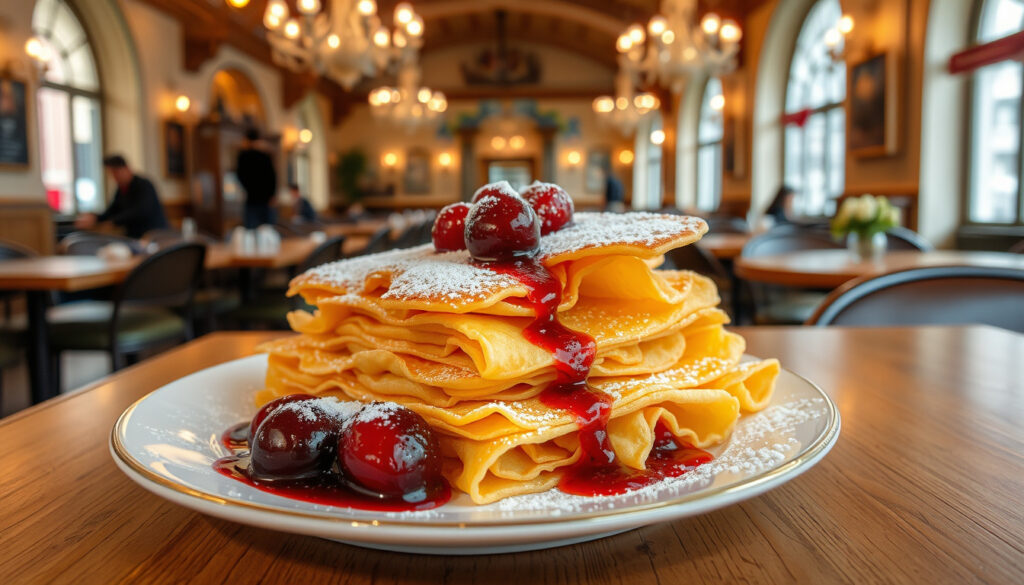
Best Kaiserschmarrn Near Me: Vienna’s Top Spots & Travel Guide
A pan of shredded caramelized pancake, a snowfall of powdered sugar, and a caption you can’t pronounce: that’s Kaiserschmarrn, and it keeps pulling travelers into Vienna’s cafés. It looks like dessert but Austrians order it as a main dish — and this source-backed shortlist explains why a plate of eggs and flour can run €18 and how to fit it into a two-day Vienna plan.
Origin: 19th-century Austria, named for Emperor Franz Joseph I · Typical price in Vienna: €10–€18 · Main ingredients: Flour, eggs, milk, sugar, butter, raisins · Usual sides: Apple sauce, plum compote, powdered sugar
Quick snapshot
- A thick pancake chopped into pieces, topped with icing sugar and served with plum compote (Visiting Vienna (independent Vienna food guide))
- One of the best-known sweets of Viennese cuisine, after Sachertorte (vienna.info (official city guide))
- Raisins commonly appear in the classic version (Vienna Tourism (city tourism board))
- Who invented it: the emperor story is a legend, not a documented fact
- Which restaurant is truly the best: no consensus exists; local lists only partly overlap
- Why a specific portion costs what it costs: no public price breakdown exists
- One Falter-featured café has probably served it in similar form since 1901 (Falter (Vienna city magazine))
- Herold.at published its top-8 Vienna list on July 3, 2020 (Herold.at (Austrian directory publisher))
- Vienna’s official recipe page remains actively maintained (vienna.info (official city guide))
- Decide between a landmark café and a neighborhood kitchen
- Build a two-day route that pairs sights with cafés
- Time the trip: May, September, and December each change the experience
One table, one shortcut: these are the numbers and names worth carrying into any ordering decision.
| Label | Value |
|---|---|
| Dish name | Kaiserschmarrn (also spelled Kaiserschmarren in official Viennese sources) |
| English meaning | “Emperor’s Mess” |
| Origin | 19th-century Austria, named for Emperor Franz Joseph I |
| Typical price in Vienna | €10–€18 per portion |
| Key ingredients | Flour, eggs, milk, sugar, butter, raisins |
| Traditional sides | Plum compote (Zwetschkenröster) or apple sauce |
| Sweet ranking | Vienna’s best-known sweet after Sachertorte |
| Best-known café in travel reels | Café Demel, with Sagmeister 1030 as the frequent runner-up |
| Popular cities | Vienna, Innsbruck, Salzburg |
Where is the best Kaiserschmarrn in Vienna?
Ask ten Viennese which café does it best and you’ll get ten answers. That’s partly because the dish is everywhere — and partly because “best” means different things on a food tour than it does on a local’s lunch break.
The shortlist local editors keep repeating
- Figlmüller at Bäckerstraße — a Viennese institution that serves Kaiserschmarrn exclusively at that location (Figlmüller)
- Landtmann’s Jausen Station — ranked among the city’s best by a local dining guide (Vienna Würstelstand (local Vienna food guide))
- A century-old café featured by Falter’s Best of Vienna — praised for a fluffy texture and a thick layer of powdered sugar (Falter)
- The top-8 local roundup published by Austria’s Herold directory on July 3, 2020 (Herold.at)
Figlmüller is the easiest benchmark. The group is best known for schnitzel, but its Kaiserschmarrn page promises a “carefully baked, fluffy and golden brown” result, served the traditional way with Zwetschkenröster — plum compote (Figlmüller). Vienna Würstelstand, a local street-food guide, gives the nod to Landtmann’s Jausen Station (Vienna Würstelstand). Read those two picks alongside Falter’s feature and the pattern snaps into focus: the locals aren’t chasing novelty. They’re chasing technique.
The names travel reels fight over: Café Demel vs Sagmeister 1030
The viral ranking treats Café Demel and Sagmeister 1030 as a two-horse race. The local-editor lists treat the dish as a citywide strength. Both are useful — one for the experience, the other for the food.
If you’ve been searching for the best Kaiserschmarrn near you, the reels almost certainly served you two names: Café Demel, a historic Viennese café with a strong reputation, and Sagmeister 1030. The Instagram buzz around both is real, and a first-time visitor could do worse than start with either. But the local shortlists above take a broader view — the same dish, executed carefully, shows up in old rooms and newer kitchens across the city.
Beyond Vienna: Innsbruck and Sölden
- Innsbruck — the same dish with an alpine backdrop
- Sölden — après-ski Kaiserschmarrn is part of the local routine
- TripAdvisor — its Vienna Kaiserschmarrn category aggregates hundreds of user ratings, if you want volume of opinion
The “near me” part of the search changes the answer. Innsbruck and Sölden show up regularly in Kaiserschmarrn discussions because the dish is a regional staple — which means the best version is usually the one within walking distance, not the one with the most famous address.
The list you trust changes what you pay and how long you wait. A local-editor shortlist favors quieter rooms and classic technique; a viral reel favors what photographs well. Know which one you’re following before you sit down.
Why is Kaiserschmarrn so expensive?
It’s a shredded pancake — and it’s also one of the most labor-intensive sweets on a Viennese menu. Once you see how it’s built, the €10–€18 price makes a lot more sense.
Ingredients and labor costs
- Fresh eggs, flour, milk, sugar and butter form the base
- Rum-soaked raisins and powdered sugar are classic additions (Vienna Tourism)
- Whipped egg whites are folded in for the signature fluffy texture
The official Viennese recipe runs through the whole sequence: beat the batter, fold in the whites, bake, tear into pieces, then caramelize with sugar in the pan (vienna.info). That last step is a hand operation — you can’t batch it like a sheet cake. The texture is judged the way you’d judge a soufflé: fluffy inside, golden outside, with crisp caramelized edges.
Tourist pricing in Vienna
- A main-course portion typically lands between €10 and €18
- Landmark cafés charge more for the room, the history, and the location
- Portions are generous — often enough for two people to share
Walk into a landmark café and you’re paying for more than eggs: the room, the service, and a brand that has been serving visitors for decades. Order the same dish in a neighborhood kitchen and the price drops. Neither choice is wrong — one is an experience, the other is lunch. The move is to read the posted menu before sitting down, because the same plate can swing meaningfully across town.
How it compares to other Austrian desserts
- Sachertorte — a slice of cake, priced like a pastry
- Apfelstrudel — a single portion, served warm
- Kaiserschmarrn — a full plate, often shared
The comparison that matters isn’t taste — it’s portion logic. Sachertorte arrives as a tidy slice; Kaiserschmarrn arrives as a full plate. In many Viennese restaurants it is served as a main course, which is exactly why the price behaves like one. Splitting a portion between two people is normal, and it changes the value calculation completely.
A plate that costs €18 in a landmark café can cost €10 in a neighborhood kitchen. The dish is the same; the overhead isn’t. You’re buying the room as much as the recipe.
Why this matters: the price of Kaiserschmarrn is the price of handwork and a good room — and once you know which one you’re paying for, the dish almost always delivers.
What are the must-sees in Vienna if I only have 2 days?
Two days in Vienna is enough to feel the city’s rhythm if you keep moving deliberately. The trick is pairing the landmarks with the food stops so nothing becomes a detour.
Day 1: the historic center
- St. Stephen’s Cathedral — the Gothic anchor of the old town
- Hofburg — the imperial palace complex
- A Kaiserschmarrn stop as the midday break
The classic first day is a walkable loop: St. Stephen’s Cathedral in the morning, the Hofburg in the early afternoon, and a café table for Kaiserschmarrn somewhere between them. The food stop isn’t a detour — it’s the reward at the midpoint that keeps the walking pace enjoyable.
Day 2: Schönbrunn and a slower afternoon
- Schönbrunn Palace in the morning — give it time, it’s large
- A flexible afternoon with no fixed plan
- A second Kaiserschmarrn if the first one already feels like a memory
Schönbrunn deserves the morning; rushing it is the most common two-day mistake. Afterward, keep the afternoon loose. The city rewards wandering, and a flexible schedule leaves room for the kind of café find that doesn’t show up in ranking lists.
Map your Kaiserschmarrn stops before you map your museums. The shortlist above is built for walking tours, so the dish can anchor a route instead of breaking it.
If you’re searching “best kaiserschmarrn near me” as a live query while walking, you’ll waste time you don’t have.
The pattern: lock in one café per day — a Figlmüller lunch, a Landtmann’s stop — and let the sights arrange themselves around it. That’s how a two-day plan feels local instead of transactional.
What to beware of in Vienna?
Vienna is a low-stress city by European standards, but it has a predictable set of tourist taxes. Knowing them is cheaper than learning them the hard way.
Menu pricing and tourist traps
- Check the posted menu before sitting down, especially near the major sights
- Be wary of combination “tourist menus” with vague descriptions
- The same Kaiserschmarrn can carry a very different price a few streets away
The trap isn’t that Viennese restaurants overcharge — it’s that some rooms near the big attractions price for one-time visitors. The fix is simple: read the menu at the door. If a plate is listed at €18 with no obvious reason, walk another block and compare.
Transport and taxis
- Use public transport — the network is fast, safe, and covers the old town
- For taxis, use official ranks or a licensed app
- Ignore unsolicited ride offers at stations and airports
Vienna’s transport system is how locals move, and a travel pass covers trams, buses and the metro within the city center. Taxi scams are rare but not unknown; the pattern is almost always an unlicensed driver charging a flat rate that has nothing to do with the meter.
Restaurant etiquette
- Rounding up the bill is standard; about 10% for good table service is the norm
- Say if you want bottled water — Viennese tap water is drinkable and often served free
- Service is included in the menu price; the tip is a gesture, not a fee
The etiquette is relaxed. A café that treats you fairly on the small things — a clear menu, a fair price, a free glass of tap water — is usually a café that’s serious about the food too.
What is the best month to visit Vienna?
Vienna has four distinct moods, and the right one depends on whether you want café weather, market weather, or shorter queues.
The shoulder seasons: May and September
- Comfortable temperatures without summer crowds
- Café gardens open, queues still manageable
- Hotel and restaurant prices below the August peak
May and September are the sweet spot: the weather is pleasant, the city is fully open, and the famous cafés still feel spacious. For a Kaiserschmarrn-focused trip, this is the easiest window to get a table without a wait.
Summer: the August trade-off
- Long days and festival energy
- Peak tourist numbers and the highest prices
- Queues at the landmark cafés
August is the classic trade-off. You get the full summer calendar, but you pay for it with crowds and heat. At the most famous cafés, that can mean standing in line for the same dish you could order sitting down in September.
Winter: Christmas markets
- December turns the old town into a Christmas-market circuit
- Warm Kaiserschmarrn works as cold-weather fuel
- Outside the market zones, the city feels calm and local
December is the wild card. The markets are the headline, and a warm plate of Kaiserschmarrn after an hour outside is one of winter’s most satisfying Vienna meals — which says a lot, because the markets are full of food.
The trade-off: May and September punish you least on price and waiting time; December rewards you with atmosphere; August is the month you visit because the calendar says so.
The shortlist, compared
Four rooms, four different reasons to order: this is what each shortlisted stop actually brings to the table.
| Spot | Signature style | Traditional side | Best for |
|---|---|---|---|
| Figlmüller (Bäckerstraße) | Fluffy, golden-brown, “carefully baked” (Figlmüller) | Zwetschkenröster (plum compote) | A proper sit-down lunch at a Viennese institution |
| Landtmann’s Jausen Station | Ranked among the city’s best by a local guide (Vienna Würstelstand) | Classic Viennese serving style | A break during a sightseeing day |
| Falter’s featured century-old café | Fluffy, with a thick layer of powdered sugar (Falter) | Fruity Zwetschkenröster | Travelers who want history on the plate |
| Café Demel | Historic café with a strong travel-reel reputation | Classic sweet sides | First-timers who want the famous address |
The trade-off: every row here is a defensible answer to “Where is the best Kaiserschmarrn near me?” Choose the definition that matches your trip — institution, local favorite, history, or famous name — and the right table becomes obvious.
The trade-off: landmark cafés vs neighborhood kitchens
There’s no wrong answer, but there is a wrong expectation. Here’s the honest split.
Upsides
- Imperial atmosphere you can’t replicate at home
- Kitchens that have made the dish for decades
- The history is part of the meal
- Reliable technique, even at peak times
Downsides
- Higher prices — often near the top of the €10–€18 range
- Queues at popular hours
- The room can outshine the plate
- A neighborhood kitchen may serve an equally good version for less
The trade-off, in one line: a landmark café sells you the room as much as the plate, while a neighborhood spot sells you the plate at a fairer price. Decide which of those you’re buying, and the choice stops being stressful.
What’s confirmed, what’s still up for debate
The research on Kaiserschmarrn is solid on ingredients, thinner on stories. Here’s the honest split.
- Kaiserschmarrn is a traditional Viennese sweet, served warm with plum compote or apple sauce (Visiting Vienna (independent Vienna food guide))
- Figlmüller’s version is served exclusively at its Bäckerstraße location (Figlmüller (Viennese restaurant institution))
- Kaiserschmarrn is often treated as a main course rather than a pastry on Viennese menus (Vienna Tourism (city tourism board))
- The story that Emperor Franz Joseph created the dish is widely repeated, but culinary historians note earlier rustic antecedents (Visiting Vienna)
- The claim that a specific café has served it “in similar form since 1901” is plausible but soft — it comes from a city magazine’s feature, not from the café’s own records (Falter)
- The “one true best” restaurant in Vienna doesn’t exist; rankings shift as new reels and reviews appear
- Whether the viral Café Demel versus Sagmeister 1030 ranking holds up in a blind tasting is impossible to settle from a video
The implication: trust the confirmed list for what you’re eating, and treat the ranking debate as entertainment. The ingredients and the classics are well documented; the “best” lists are opinions with good lighting.
What travelers are saying
The online debate is loud and contradictory, which is exactly why the source-backed list above is the better travel companion. Still, two quotes capture the range.
“The flavor was phenomenal, and it clearly was a high quality dish.”
— @foodietraveler, Instagram food reel about Sagmeister 1030 in Vienna
“For Kaiserschmarrn, Gasthaus Penalty is the only right answer.”
— Reddit user in r/zurich, defending a Swiss favorite
The pattern: one speaker is praising precision technique in Vienna; the other is defending a local favorite hundreds of kilometers away. Both are right, because Kaiserschmarrn is a regional dish with strong opinions attached — and neither quote is a substitute for the confirmed facts above.
The takeaway for your Vienna trip
For travelers landing in Vienna with a two-day window, the choice is simpler than the rankings suggest. Pick one landmark café for the full imperial experience and split the portion; pick one neighborhood spot for honest pricing; and let the dish anchor your route between St. Stephen’s Cathedral, the Hofburg, and Schönbrunn. For anyone who searches “best kaiserschmarrn near me” before checking a local-editor source, the risk is clear: you’ll get a beautiful photo and a €18 bill — and you may still miss the version the city itself would order.
tripadvisor.de, wanderlog.com, wien.info, tripadvisor.com, figlmueller.at
Frequently asked questions
What is Kaiserschmarrn?
Kaiserschmarrn is a traditional Viennese sweet made from a thick pancake batter enriched with whipped egg whites, baked, torn into pieces, and caramelized with sugar. The city’s tourism board calls it the “Emperor’s Mess,” and it is usually served warm with plum compote or apple sauce.
How is Kaiserschmarrn made?
The official method beats a pancake batter, folds in whipped egg whites for a fluffy texture, bakes the pancake, then tears it into pieces and caramelizes each piece with sugar in the pan. Rum-soaked raisins are a classic addition, and the finished dish is dusted with powdered sugar.
Is Kaiserschmarrn gluten-free?
No. Flour is a core ingredient, so the classic dish is not gluten-free. If you’re ordering out, ask the kitchen directly whether they can prepare a wheat-free version.
Can I make Kaiserschmarrn at home?
Yes. Vienna.info publishes a step-by-step recipe, first posted in March 2021 and most recently updated in October 2026, covering the batter, the whipped egg whites, and the final caramelization (vienna.info).
What drinks go with Kaiserschmarrn?
A Viennese coffee — a melange or a cappuccino — is the classic pairing. At dinner, a light white wine suits the dish’s balance of sweet and savory notes.
Are there vegetarian Kaiserschmarrn options?
Yes. The classic version is made with flour, eggs, milk, sugar, and butter, so it is already vegetarian. It is not vegan. If the kitchen uses rum-soaked raisins, that’s still vegetarian, but it’s worth knowing if you’re avoiding alcohol.
Related reading
- Pepper Steak Near Me: A Complete Guide to Finding & Enjoying — another “near me” dining search, decoded
- Happy Hour Near Me in Dublin: Best Deals & Iconic Pubs — the same location-first approach for Dublin nights
More related posts
 What to Do in Nara: Top Attractions & Day Trip Tips
 Chinese New Year Snacks – Traditions, Recipes and Symbolism
 Bread Street Kitchen Reviews: Is It Worth It? (2025 Guide)
 Is Stomach Flu Contagious? Timeline & When to Isolate
 Canton Paradise Star Vista: Menu, Reservations, Reviews
 Old Upper Thomson Road: Grand Prix Past & Park Connector
 Yat Ka Yan Menu 2025 – Full Prices, Outlets & Desserts
 What Is a Notice Period? Guide for Irish Employees