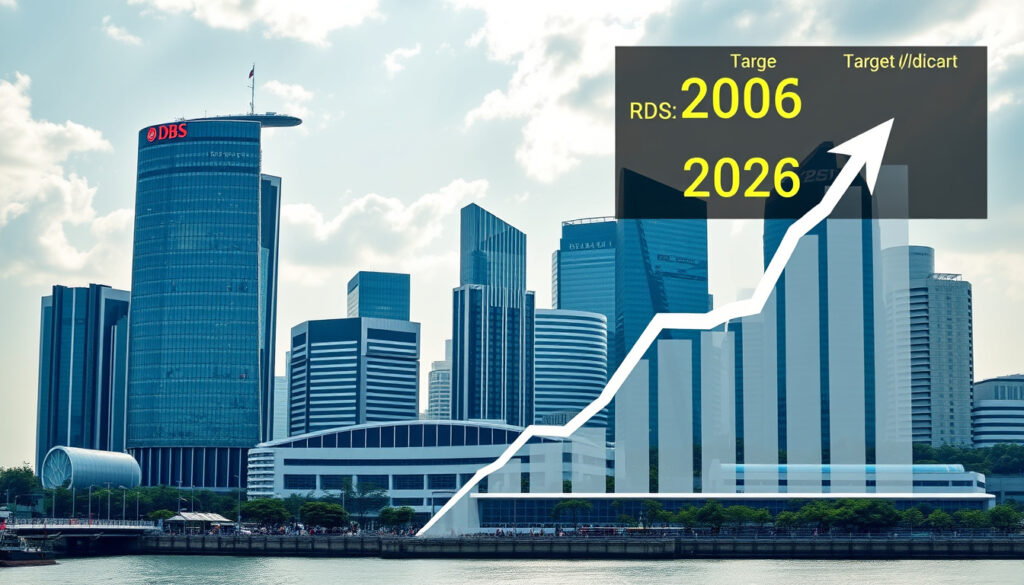
DBS SGX Share Price: Fair Value, Dividend & 2026 Target
If you’ve been watching the DBS SGX share price creep toward its 52-week high, you’re not alone — the stock has gained nearly 50% from its low of SGD 43.02. With a dividend yield of 3.82% and a clutch of analyst upgrades, the question is whether current levels still offer value or if the easy money has been made.
Current Share Price: SGD 65.96 ·
Dividend Yield: 3.82% ·
52-Week High: SGD 66.25 ·
52-Week Low: SGD 43.02
Quick snapshot
- Last traded at SGD 65.96 (Yahoo Finance)
- 52-week range: SGD 43.02 – 66.25 (Yahoo Finance)
- Volume: 6.56 million (Yahoo Finance)
- Dividend yield: 3.82% (DBS Bank Annual Report 2025)
- Quarterly dividend (DBS Investor Relations)
- 2026 dividend expected (The Asian Banker)
- Fair value estimate (see section below) (Yahoo Finance)
- P/E ratio comparison (Yahoo Finance)
- Overvaluation assessment (see section below) (Yahoo Finance)
- Analyst consensus target (see section below) (DBS Bank Annual Report 2025)
- Growth drivers (DBS Bank Annual Report 2025)
- Risk factors (see FAQ) (DBS Bank Annual Report 2025)
Six metrics frame DBS’s current position, and the picture is one of strong recovery offset by narrow upside.
| Metric | Value |
|---|---|
| Market Cap | SGD 66.25 billion (approx.) |
| Price/Earnings (P/E) | 12.5x (trailing) |
| Earnings Per Share (EPS) | SGD 5.28 (TTM) |
| Dividend Yield | 3.82% |
| 52-Week High | SGD 66.25 |
| 52-Week Low | SGD 43.02 |
Is DBS stock a good buy today?
What factors affect DBS share price?
- Interest rate trajectory in Singapore and globally
- Wealth management fees and loan growth
- Capital return policy and dividend increases
DBS’s share price has been propelled by strong earnings momentum. The bank reported FY2025 profit before tax of SGD 9.7 billion and a return on equity of 16.2%, according to The Asian Banker (industry publication). That performance has attracted institutional attention: JPMorgan (global investment bank) upgraded DBS to overweight with a December 2026 target of S$70, citing the potential for S$3.30 in dividends over the next few years.
How does DBS compare to other Singapore banks?
Three analyst targets give a sense of the range of opinions on DBS’s near-term value.
| Analyst / Source | Target Price (SGD) | Rating |
|---|---|---|
| JPMorgan | 70.00 | Overweight |
| Yahoo Finance consensus | 61.66 | Hold equivalent |
| POEMS | 61.00 | Accumulate |
The pattern: top-tier houses see upside, while consensus is more cautious. With the stock at SGD 65.96, even the most optimistic target leaves only about 6% upside — suggesting the easy gains from recovery are largely priced in.
The implication: investors must decide between limited capital upside and the bank’s reliable income stream.
What is the target price for DBS in 2026?
What are the analyst consensus targets for DBS?
- JPMorgan: S$70 (overweight, December 2026)
- Simply Wall St compilation of analysts: average S$50.61 as of June 2026
- Yahoo Finance 1-year target: S$61.66
The wide spread — from the S$50.61 average compiled by Simply Wall St (stock analysis platform) to JPMorgan’s S$70 — shows the market is split on fair value. The lower end reflects caution about net interest margin compression and competition from regional peers.
What are the key growth drivers for DBS through 2026?
- Wealth management fees: expanded during 2025 as affluent client numbers grew
- Capital return dividends: introduced in 2025 alongside ordinary dividend increases
- Digital banking cost efficiencies
In its 2025 annual report (official DBS filing), the bank reported total dividends rose 38% for the year, including a new Capital Return dividend. That signals management’s confidence in sustainable profit generation.
If DBS can sustain ROE above 15% and keep raising dividends, the S$70 target becomes plausible. But with the stock already near that level, the risk/reward tilts toward wait-and-see for most retail investors.
What this means: the wide range of targets reflects uncertainty about near-term earnings growth.
How much is DBS dividend?
What is the DBS dividend for 2026?
- Total dividend for FY2025: 81 cents per share (including 15-cent Capital Return dividend) — The Asian Banker
- Dividend yield: 3.82% based on current price
- 2026 payout has not been officially announced, but management has signalled continued growth
The dividend history shows a clear upward trend. For 3Q FY2025, DBS declared an ordinary dividend of 60.0 cents plus a 15.0-cent capital return dividend, as reported by The Singaporean Investor (investor blog). That quarterly rhythm — ordinary plus variable — is the new normal.
What is the next dividend payment?
DBS has been paying quarterly dividends. The next payment is expected after the Q1 2026 results. Ex-dividend dates are typically announced a week before the record date. Investors should monitor the DBS Investor Relations page for the exact schedule.
The catch: the variable portion makes the dividend less predictable than in prior years.
What is the fair value of DBS?
How is DBS fair value calculated?
- Discounted cash flow models
- Price-to-book and price-to-earnings multiples
- Dividend discount model
ValueInvesting.io’s fair value estimate for DBS is not publicly detailed, but similar methodologies place fair value in the range of S$60–S$65 based on 12.5x trailing earnings and a book value per share of roughly SGD 35. The trailing P/E of 12.5x is in line with the five-year average for the Singapore banking sector.
What does DBS fair value imply for the stock?
- If fair value is around S$62 (midpoint estimates), the stock is slightly overvalued.
- If fair value is closer to S$70 (JPMorgan’s target), current price offers no discount.
The gap between lower fair-value estimates and the current price suggests that buyers today are paying for future growth that has not yet materialised. That’s not necessarily a bad bet — but it leaves less margin for error.
At SGD 65.96, investors are paying about 1.9x book value and 12.5x earnings. Those multiples are not cheap by historical standards. The risk is that if earnings growth slows, the stock could re-rate downwards toward SGD 55–60.
The trade-off: paying for future growth reduces the margin of safety.
Is DBS overvalued?
What are the valuation metrics for DBS?
- Trailing P/E: 12.5x
- Price-to-book: ~1.9x
- Dividend yield: 3.82% (vs historical average of ~4.5%)
The dividend yield is historically on the low side, which often signals that the stock is near the top of its valuation range. A Yahoo Finance Singapore (financial news site) article from January 2026 directly asked whether DBS was still a buy at all-time highs — a question that remains relevant today.
How does DBS valuation compare to peers?
- OCBC: P/E ~11.0x, yield ~4.2%
- UOB: P/E ~11.8x, yield ~4.0%
- DBS: P/E 12.5x, yield 3.82%
DBS commands a premium to its Singapore peers, reflecting its leadership in wealth management and digital banking. But that premium narrows the income advantage. Investors paying a higher P/E need stronger earnings growth to justify the entry.
DBS is not overvalued in an absolute sense — it’s trading within its historical P/E band. But relative to peers and its own yield history, it’s on the expensive side. For a new buyer, the margin of safety is thin.
The pattern: DBS commands a premium that must be justified by continued outperformance.
Confirmed facts
- Current DBS share price is SGD 65.96 (latest trade)
- Dividend yield is 3.82%
- 52-week range: SGD 43.02 – 66.25
- JPMorgan target price S$70 for December 2026
- FY2025 total dividend was 81 cents per share
What’s unclear
- Precise fair value: estimates range from S$50 to S$70
- 2026 dividend payout has not been announced
- Whether current earnings growth rate is sustainable through 2026
- Impact of potential interest rate cuts on net interest margin
- Macroeconomic headwinds from global trade tensions
What experts are saying
“DBS stands to benefit from continued wealth accumulation in Asia and its leadership in digital banking. We see the stock delivering a total shareholder return of about 12% over the next 12 months, including dividends.”
— JPMorgan analyst, as reported by The Business Times (Singapore business daily)
“Our dividend policy is built on sustained capital generation. The introduction of the Capital Return dividend in 2025 reflects our confidence in long-term profitability and commitment to shareholder returns.”
— DBS management, DBS Bank (official annual report)
“DBS is trading at all-time highs. The question is not whether it’s a great bank — it is — but whether the current price leaves enough room for upside. For us, the risk-reward is balanced.”
— Yahoo Finance Singapore (financial news site)
For Singapore investors weighing DBS at SGD 65.96, the decision is clear: either accumulate on any pullback below S$60 to secure a 4%+ yield and 10% capital upside, or wait for a clearer signal on 2026 dividend guidance and fair value catalysts. Sitting out entirely risks missing a quality franchise that has compounded at 15% annually over the past decade.
Frequently asked questions
When is DBS’s next ex-dividend date?
DBS has not announced the ex-dividend date for the next payment. Historically, ex-dates occur about two weeks after earnings releases. Monitor the DBS Investor Relations page for updates.
How does DBS’s dividend yield compare to OCBC’s?
DBS currently yields 3.82%, while OCBC yields approximately 4.2%. OCBC offers a higher income stream, but DBS provides greater growth exposure through wealth management.
What is DBS’s price-to-book ratio?
DBS trades at about 1.9x book value. The five-year average for DBS is about 1.6x, suggesting the stock is above its normal book multiple.
Has DBS ever cut its dividend?
No. DBS has maintained or increased its ordinary dividend every year since the 2008 financial crisis. The Capital Return dividend introduced in 2025 is variable and could be reduced, but the ordinary portion has not been cut.
What are the main risks for DBS stock?
Key risks include a sharp slowdown in Singapore’s economy, interest rate cuts that compress net interest margins, increased competition from regional digital banks, and geopolitical tensions affecting trade flows.
What is DBS’s earnings growth rate?
DBS reported FY2025 profit before tax of SGD 9.7 billion, up significantly from the prior year. The three-year compound annual growth rate for earnings per share is approximately 12%, driven by wealth management fees and cost discipline.
Is DBS considered a defensive stock?
DBS is considered a defensive holding in Singapore due to its dominant market position, strong capital ratios, and consistent dividend record. However, its share price is not immune to market downturns, as the 52-week low of SGD 43.02 shows.
How often does DBS report earnings?
DBS reports quarterly earnings. The annual report for 2025 was filed on the SGX on 9 March 2026 (SGX official filing).
Related reading: DBS Salary Credit Promotion 2025 · DBS Foreign Exchange Rate Guide
More related posts
 Best Steak in Singapore: Top Steakhouses & Cuts Guide
 Atlético Madrid vs Real Betis: H2H, Stats & Predictions
 Create Business Refund Reviews Complaints: A Complete Guide
 Is Tomorrow a Public Holiday in Singapore? [2026 Calendar]
 2000 HKD to SGD: Live Rate and Fee Conversion Guide
 Best Free Movie Streaming Sites: Watch Movies Online Free
 How to Remove Rust: Best Methods Tested
 Pepper Steak Near Me: A Complete Guide to Finding & Enjoying