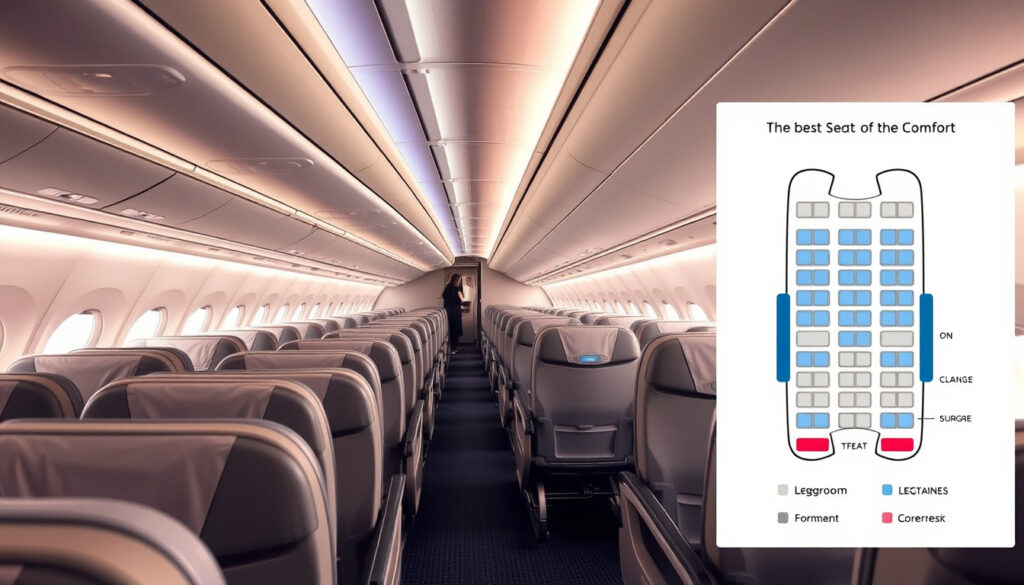
A350-900 Seat Map: Best Seats, Cabin Layout & Comfort Guide
There’s a moment every traveler knows: you’ve booked your flight on an Airbus A350-900, and now you’re staring at a seat map trying to figure out which seat is worth paying extra for and which one feels like a penalty box. The A350-900 is one of the most popular wide-body jets flying today, but its seat maps vary wildly from one airline to the next — what works on Singapore Airlines might be a dud on Delta.
Length: 66.8 m (219 ft 2 in) ·
Wingspan: 64.8 m (212 ft 7 in) ·
Typical seating capacity: 300–440 passengers ·
Range: 15,000 km (8,100 nmi) ·
Cabin width: 5.6 m (18 ft 4 in) ·
First delivery: 2014
Quick snapshot
- Cabin width is 5.6 m (SeatMaps seat map aggregator)
- Standard economy layout is 3-3-3 (SeatMaps seat map aggregator)
- Business class seats are lie-flat on most carriers (Mainly Miles travel blog)
- Exact seat pitch varies by airline and is not standardized
- Future retrofit plans for specific airlines may change seat maps
- First flight: 14 June 2013
- Entry into service: 15 January 2015 (Qatar Airways)
- Over 500 delivered by 2024
- Airlines continue to refresh cabins; new Allegris suites on Lufthansa (SeatMaps seat map aggregator)
- More carriers adopting premium economy (SeatMaps seat map aggregator)
| Attribute | Value |
|---|---|
| First flight | 14 June 2013 |
| Entry into service | 15 January 2015 (Qatar Airways) |
| Number of seats (typical) | 300–440 |
| Maximum takeoff weight | 283,000 kg (623,900 lb) |
| Maximum speed | Mach 0.89 (1,060 km/h) |
| Typical range | 15,000 km (8,100 nmi) |
| Cabin width | 5.6 m (18 ft 4 in) |
Where is the best place to sit on an A350-900?
Best seats in economy class
- Exit row and bulkhead seats offer extra legroom. On Cathay Pacific’s A350-900, extra-legroom Economy seats are at the front of the last economy cabin section (Cathay Pacific airline official).
- Row 11 and row 19 on Singapore Airlines’ long-haul A350-900 have extra foot space, according to Mainly Miles travel blog.
- Window seats near the back may have narrower fuselage taper — avoid rows where the walls curve in.
Exit rows give you legroom but often have thinner padding and colder floors. For long haul, a bulkhead seat with a footrest can be more restful.
Best seats in business class
- Business class on most A350-900s offers lie-flat beds with direct aisle access. On Air France’s 292-seat layout, Business seats have 74-inch pitch (SeatMaps seat map aggregator).
- Some carriers feature “throne” seats in a staggered 1-2-1 configuration — look for rows away from the galley and lavatories.
The implication: premium cabin comfort depends more on row placement than the seat type itself. Avoiding galley noise is often the difference between a restful flight and a disrupted one.
Seats to avoid on the A350-900
- Seats near the rear galley may have more noise and traffic.
- On Cathay Pacific’s A350-900, seats 59A and 59K have no window (Cathay Pacific airline official).
- Delta’s A350 economy is split into two cabins — avoid the very last row where reclining is restricted (The Points Guy travel advice site).
A poorly chosen seat on an 8-hour flight can mean the difference between arriving rested and arriving stiff. The same aircraft type delivers very different comfort levels depending on which row you pick.
What is the A350-900’s cabin layout?
Three-class vs two-class configurations
Airlines configure the A350-900 in multiple ways. Common three-class layouts include Business, Premium Economy, and Economy. For example, Singapore Airlines’ long-haul A350-900 has 42 Business, 24 Premium Economy, and 187 Economy seats (Mainly Miles travel blog). Cathay Pacific’s version carries 38 Business, 28 Premium Economy, and 214 Economy in five separate cabin sections (Cathay Pacific airline official).
Typical seat counts by airline
Variation is the norm. Air France flies a 324-seat A350-900 with 34 Business, 24 Premium Economy, 266 Economy, and also a 292-seat version with 48 Business, 32 Premium Economy, 212 Economy (SeatMaps seat map aggregator). Delta operates at least three configurations: 306 seats, 339 seats, and a 275-seat version with more premium seats (SeatMaps seat map aggregator). Lufthansa’s new Allegris layout has 4 First, 38 Business, 24 Premium Economy, 201 Economy (SeatMaps seat map aggregator).
Cabin width of 5.6 m allows 9-abreast in economy (3-3-3) as standard. Some carriers offer 8-abreast (2-4-2) in a few rows for more comfort — check the seat map before booking.
The catch: what looks like the same aircraft can feel like two different planes depending on which airline’s seat map you draw. Blind booking is a gamble.
Is the A350-900 a big plane?
A350-900 compared to Boeing 777-300ER
- A350-900 length: 66.8 m; 777-300ER: 73.9 m — the 777 is 7.1 m longer.
- Wingspan: both 64.8 m (212 ft 7 in).
- Typical seat capacity: A350-900 maxes around 440, while the 777-300ER can carry up to 550 in high-density layouts.
The cabin width of the A350-900 (5.6 m) is slightly narrower than the 777’s 5.87 m, which means 10-abreast on the 777 is tighter than 9-abreast on the A350.
The pattern: the A350-900 trades overall length for the same wingspan as the 777, making it a more efficient shape for airlines.
| Metric | A350-900 | 777-300ER | A380 |
|---|---|---|---|
| Length | 66.8 m | 73.9 m | 72.7 m |
| Wingspan | 64.8 m | 64.8 m | 79.8 m |
| Typical seats | 300–440 | 350–550 | 500–850 |
| Range | 15,000 km | 13,650 km | 14,800 km |
The A350-900 is noticeably shorter than the 777-300ER but shares the same wingspan. It’s smaller than the A380 in every dimension except range, where it slightly edges the A380.
For passengers, the A350-900 feels roomy in the cabin because of its wide fuselage and high ceilings, but it’s not the biggest bird in the sky. Those who want maximum space per seat should check if their carrier uses 8-abreast in economy.
Is the A350-900 a comfortable plane?
Cabin pressure and humidity
The A350-900’s cabin is pressurized to an altitude of 6,000 ft (1,830 m), compared to 8,000 ft on older aircraft like the 777 or A330. Higher humidity levels reduce dehydration. These features, combined with advanced composite materials, make the cabin environment noticeably more comfortable on long flights.
Seat width and pitch
- Economy seat width on 9-abreast A350-900 ranges from 17 to 18 inches (43–46 cm), depending on the airline’s seat choice.
- Seat pitch varies widely: typically 31–33 inches in standard economy, but can drop to 30 on some high-density layouts.
- Premium economy usually offers 38–40 inches pitch with wider seats (19–20 inches).
Noise levels
The Rolls-Royce Trent XWB engines are among the quietest in service. The A350-900 is certified under ICAO Chapter 14, making it up to 50% quieter than older wide-bodies on takeoff and approach. Inside, the cabin noise is lower than on the 777 or A330, especially in the forward section.
The implication: the A350-900’s engineering genuinely reduces passenger fatigue, making it a strong choice for ultra-long-haul routes regardless of which seat you pick.
What is the 3 seat economy trick?
How to get an empty middle seat
The 3-seat trick involves booking a window seat and an aisle seat in the same 3-seat row, hoping the middle seat stays empty. If the flight isn’t full, no one will take that middle seat — giving you two seats to yourself. Some travelers book two seats close to departure and cancel one just before check-in, but that’s not guaranteed to work.
Booking two aisle seats across from each other
Another variation: book two aisle seats in adjacent rows across the aisle. If the flight is light, you may get both rows to yourself. This works best on routes with low load factors, typically Tuesday or Wednesday departures.
Upsides and Downsides of A350-900 Seating
Upsides
- Wide cabin (5.6 m) means less squeeze in 9-abreast economy compared to 10-abreast on 777
- Lie-flat business with direct aisle access on most carriers
- Premium economy offers genuine step-up in comfort on many airlines
- Quieter engines and better cabin pressure reduce fatigue
Downsides
- Seat maps differ so much that you can’t rely on a standard layout
- Some carriers pack 9-abreast with 17-inch seats, which is tight for larger passengers
- Window seats near the tail can be tapered and claustrophobic
- Extra-legroom seats often book up quickly or come with a surcharge
What the evidence shows – confirmed and unclear
Confirmed facts
- A350-900 cabin width is 5.6 m
- Standard economy layout is 3-3-3
- Business class seats are lie-flat on most carriers
What’s unclear
- Exact seat pitch varies by airline and is not standardized
- Future retrofit plans for specific airlines may change seat maps
Expert and passenger voices
The A350-900’s 5.6-meter cabin width gives airlines the flexibility to offer either 9-abreast in economy or a more spacious 8-abreast layout. Official Airbus specifications show this is the widest single-aisle cabin among current long-haul twinjets.
Airbus (manufacturer)
Our A350-900 has five cabin sections: two Business class, one Premium Economy, and two Economy. Emergency exit rows are at the front of the last Economy cabin, and extra-legroom seats are there as well. Passengers should note that seats 59A and 59K have no window.
Cathay Pacific (airline official)
Delta’s A350 economy cabin is split into a forward section of 90 seats and a rear section of 136 seats. The rear bulkhead row 40 has paired seats – a rare find in economy that gives you two seats next to each other without a middle passenger.
The Points Guy (travel advice site)
What it means for your next booking
The A350-900 is a genuinely comfortable aircraft, but the experience you get depends on the airline’s seat map and your willingness to research. Book an exit row or premium economy if budget allows; use the 3-seat trick only on flights below 70% load. For travelers flying Delta, Cathay Pacific, Singapore Airlines, or Lufthansa, the specific seat map is available from each carrier’s website. For everyone else, the best seat on an A350-900 is the one you picked after checking the map, not the one the algorithm gave you.
seatmaps.com, youtube.com, seatcompare.ai, tripadvisor.com, instagram.com, reddit.com, reddit.com
For a detailed look at how the layout varies by route, check the Singapore Airlines A350-900 seat map to see differences between regional and long-haul configurations.
Frequently asked questions
How many seats does the A350-900 have?
Typical seating capacity ranges from 300 to 440 passengers, depending on the airline’s configuration. A common layout is around 300–350 in three classes.
What is the seat width in economy on the A350-900?
On a 9-abreast (3-3-3) layout, economy seat width is typically 17 to 18 inches (43–46 cm). Some airlines with 8-abreast can offer 19 inches.
Does the A350-900 have USB ports?
Yes, most A350-900s are equipped with USB-A and sometimes USB-C ports at each seat, along with power outlets. Check your airline’s seat details.
Is the A350-900 quieter than the 777?
Yes, the A350-900 is significantly quieter inside due to the Rolls-Royce Trent XWB engines and composite fuselage. It is up to 50% quieter on takeoff than older wide-bodies.
Can you sleep on an A350-900 in economy?
In economy, sleep quality depends on seat pitch and width. Exit rows or bulkhead seats offer more space. Premium economy is more suitable for restful sleep.
What is the difference between A350-900 and A350-1000?
The A350-1000 is 7 m longer and seats about 40–60 more passengers. It has a slightly longer range and a different seat layout, but the cabin width is the same.
More related posts
 Row Row Row Your Boat: Lyrics & Dark Meaning
 How to Reduce Cholesterol: 7-Day Diet & Lifestyle Plan
 The GUILD International College: Inclusive Learning for Ages 7-35
 Private Driving Instructor List: Find RSA-Approved ADIs
 Tamil Yogi Movie Download 2025: Risks & Legal Alternatives
 IKEA Singapore Opening Hours 2025: Tampines & Alexandra
 Download TikTok Videos Without Watermark: Free HD Tools
 Evolving Skies Booster Box: Price & Investment Outlook