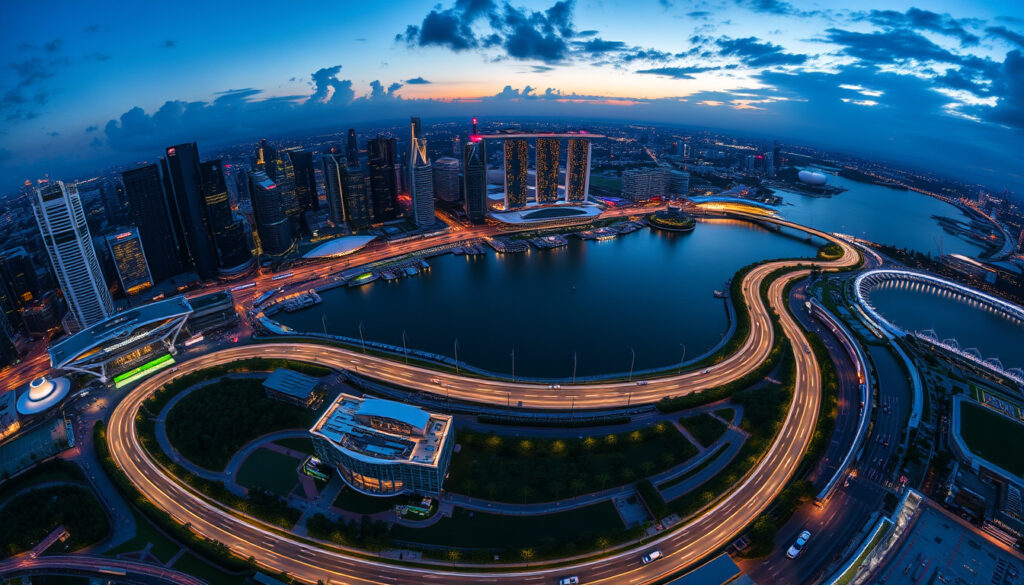
Marina Bay Street Circuit: F1 Track Guide & Visitor Info
The Marina Bay Street Circuit is more than just a backdrop for the Formula 1 night race—it’s a 5.063 km stretch of public road that demands everything from drivers. This guide unpacks why this track is one of the toughest on the calendar, how you can experience it yourself, and where it ranks among the world’s most famous circuits.
Track Length: 5.063 km ·
Number of Turns: 23 ·
Lap Record: 1:34.486 (Lewis Hamilton, Mercedes, 2023) ·
Race Laps: 61 ·
First Grand Prix: 2008
Quick snapshot
- Circuit length: 5.063 km (Formula 1)
- First night race in F1 history, launched in 2008 (Singapore GP official site)
- Public road accessible outside race weekends (Singapore GP official site)
- Exact opening hours for public walking/running on the circuit are not uniformly published
- Ranking of “prettiest” F1 track is subjective and not officially measured
- Specific ticket prices for 2026 are not yet fixed
- 2008: First Singapore Grand Prix held as a night race (Sky Sports)
- 2023: Track layout revised to 19 turns after removal of Turns 16-19 (Sky Sports)
- 2026: Next Singapore Grand Prix scheduled for September (Sky Sports)
- 2026 race date to be confirmed by F1 calendar
- Potential further layout changes as Singapore’s urban development continues
- Growing interest in walking/running events on the circuit
The Marina Bay Street Circuit packs a lot of numbers into its 5.063 km loop. Here are the key specs that define this track.
| Specification | Value | Source |
|---|---|---|
| Track Length | 5.063 km (3.146 mi) | Formula 1 |
| Turns | 23 (14 right, 9 left) | Formula 1 |
| Lap Record | 1:34.486 (Lewis Hamilton, Mercedes, 2023) | Formula 1 |
| First Race | 2008 | Singapore GP official site |
| Number of Laps | 61 | Formula 1 |
| Average Speed | approx. 165 km/h (103 mph) | Motorsport.com |
The pattern: a long lap with many corners, moderate speed, and a race distance that pushes fuel and tyre strategies to the limit.
What is the Marina Bay Street Circuit in Singapore?
Location and layout of the Marina Bay Street Circuit
The Marina Bay Street Circuit is a 5.063 km street circuit that winds through the heart of Singapore’s downtown, passing landmarks like the Singapore Flyer, the Helix Bridge, and the Marina Bay Sands. The track is a temporary circuit—it uses public roads that are closed for the race weekend. According to Formula 1’s official circuit page, the layout features 23 turns, many of them low-speed, making it one of the most technical circuits on the calendar.
- Length: 5.063 km
- Turns: 23 (14 right, 9 left)
- Race distance: 308.706 km (61 laps)
- First used: 2008
Drivers get almost no rest: the circuit’s length and number of turns mean constant braking and accelerating.
History of the Singapore Grand Prix
The Singapore Grand Prix made its debut in 2008 as the first ever night race in Formula 1 history. The Singapore GP official site notes that the event was an instant hit, combining the novelty of floodlit racing with the city’s skyline. The track layout has evolved over the years. In 2013, the infamous “Singapore Sling” chicane was removed. More recently, for the 2023 race, the end-of-lap section was shortened after construction of NS Square removed Turns 16 through 19, leaving a 19-turn layout as confirmed by Sky Sports.
The implication: each layout change has aimed to improve overtaking opportunities while maintaining the circuit’s unique character as a tight, demanding street track.
Why is Singapore F1 difficult?
Physical demands on drivers
The Singapore Grand Prix is widely regarded as one of the most physically demanding races on the calendar. Formula 1 describes the circuit as “one of the most physically demanding” due to its bumpy street surface and the tropical heat and humidity. Drivers lose up to 3 kg of body weight during the race. Former driver Jolyon Palmer, quoted by Formula 1, says the lap is “long, complex, and draining, a little bit like Monaco, with plenty of bumps.”
- Heat and humidity: ambient temperatures around 30°C, with humidity above 80%
- Bumpy surface: the street circuit is not as smooth as permanent tracks
- Long race duration: often exceeding 2 hours
Drivers must maintain peak concentration for over 2 hours in sauna-like conditions—a recipe for errors that can decide the race.
Track characteristics that increase difficulty
Beyond the climate, the track itself is punishing. The Marina Bay Street Circuit has 23 corners, many of them low-speed, requiring precise braking and throttle control. The narrow track width and limited runoff areas mean there’s little margin for error. Motorsport.com notes that the average distance between turns is about 260 metres, making it a series of short bursts rather than a flowing rhythm. Turn 7 is particularly tricky—Formula 1 warns that it’s easy to run wide under braking.
The trade-off: the very factors that make Singapore difficult also make it a spectacle—crashes, safety cars, and strategy gambles are common.
Can you walk or run the F1 track in Singapore?
Public access to the Marina Bay Street Circuit
Yes—the Marina Bay Street Circuit is a public road network when the F1 event is not active. According to the Singapore GP official site, the circuit roads are open to pedestrians and runners 24/7 except during race preparation periods and the Grand Prix weekend itself. This means you can walk or run the exact same tarmac that F1 cars race on.
For a self-guided tour, start at the Jubilee Bridge near the floating platform, follow the route past the Singapore Flyer, and loop around the Marina Bay financial district. The full route is approximately 5 km—perfect for a morning jog.
For casual visitors, the circuit is simply a great walking route with stunning skyline views. For running enthusiasts, it’s a bucket-list lap.
Official walking and running events on the track
There are organized running events that allow participants to run the full track. The Marina Bay Street Circuit Challenge, for example, is a timed race that uses the exact F1 layout. These events are typically announced on the Singapore GP official site and local running club calendars. The circuit is closed for vehicle use during F1 preparation (usually 2-3 weeks before the race) and the race weekend itself, so plan your visit accordingly.
The pattern: while the track is generally open, the best way to guarantee a full lap without traffic is to join an organized race.
How does the Marina Bay Street Circuit compare to other F1 tracks?
Six key metrics, one story: Marina Bay sits in a class of its own for physical difficulty, but it’s not the fastest or the deadliest. Here’s how it stacks up against the extremes.
| Metric | Marina Bay Street Circuit | Monaco | Nürburgring Nordschleife | COTA |
|---|---|---|---|---|
| Track Length | 5.063 km | 3.337 km | 20.832 km (historical) | 5.513 km |
| Number of Turns | 23 (19 after 2023) | 19 | 154 (historical) | 20 |
| Average Speed | ~165 km/h | ~155 km/h | ~160 km/h (historical) | ~210 km/h |
| Difficulty Rating | Extreme (heat + bumps) | Extreme (tight) | Extreme (length + danger) | Moderate |
| First F1 Race | 2008 | 1950 | 1951 | 2012 |
| Unique Feature | First night race | Street circuit principality | Longest/historic | Purpose-built, elevation |
The pattern: Marina Bay rivals Monaco for corner density and physical strain, but adds the humidity factor that no other track can match.
Hardest F1 track in the world
While the Nürburgring Nordschleife is historically the most dangerous and demanding track (with multiple fatalities in the pre-1970 era), among current circuits, the Marina Bay Street Circuit is a top contender for hardest. Motorsport.com calls it “F1’s toughest race” due to the combination of heat, humidity, bumps, and corner density. The lap record is 1:34.486, set by Lewis Hamilton in 2023.
Easiest F1 track in the world
Driver feedback and average lap speeds suggest the Circuit of the Americas (COTA) is often cited as the easiest F1 track. Its wide corners, smooth surface, and flowing layout allow drivers to push hard without the risk of hitting walls. In contrast, Marina Bay rewards precision over raw speed.
Slowest F1 track in the world
Monaco is the slowest F1 track by average speed (around 155 km/h), followed closely by Marina Bay at approximately 165 km/h. Motorsport.com confirms that Marina Bay’s average race lap times are second only to Monaco on the slowest list.
Most fatal F1 track in history
The most fatal F1 track is the Nürburgring Nordschleife, which claimed multiple lives during the 1950s and 1960s before being removed from the calendar. The Marina Bay Street Circuit has had no F1 race fatalities, which is a testament to modern safety standards.
What is the prettiest, most boring, and worst F1 track?
Prettiest F1 track opinions
Beauty is subjective, but fans frequently name Monaco, Suzuka, and the Marina Bay Street Circuit as the most visually stunning. The night-time spectacle of Singapore’s skyline, with the Marina Bay Sands glowing under floodlights, makes it a strong contender. Singapore GP official site highlights the “breathtaking views” of the city from the circuit.
Most boring F1 track according to fan surveys
Circuits with long straights and few elevation changes tend to be called boring. The Hungaroring and Sochi Autodrom are frequent mentions. Marina Bay, with its 23 corners and constant action, rarely appears on boring lists—it’s too busy.
Worst F1 track criticisms
Driver satisfaction surveys often rank the Circuit de Barcelona-Catalunya and Paul Ricard as the worst due to poor overtaking opportunities and sterile surroundings. Marina Bay, while difficult to overtake on, is praised for its atmosphere and challenge.
The pattern: Marina Bay doesn’t top the “worst” lists because its unique character—night race, city setting, physical demands—gives it a personality that purpose-built tracks lack.
If you’re looking for pure racing spectacle, Marina Bay delivers overtakes less often than Bahrain or Monza, but the drama of a night race with safety cars and strategy calls compensates.
Marina Bay Street Circuit: essential information for visitors
Marina Bay Street Circuit opening hours and public access
The circuit roads are public roads, so they are open to pedestrians and cyclists 24/7 except during F1 preparation and race weekend. The closure period typically starts 2-3 weeks before the race and lasts until the Monday after. For the most up-to-date closure dates, check the Singapore GP official site.
- Normal access: free, no ticket needed
- Best time to walk/run: early morning or late evening to avoid heat
- Duration: about 1 hour walking, 25-30 minutes running
How to buy Marina Bay Street Circuit tickets
Tickets for the Singapore Grand Prix are sold through the official Formula 1 website and authorized partners. Prices vary by zone and package. The circuit is divided into four zones: Zone 1 (Padang) near the start/finish straight, Zone 2 (Bay) with views of the bay, Zone 3 (Marina) near the floating platform, and Zone 4 (Stadium) near the Singapore Sports Hub.
For 2026, prices are not yet fixed, but expect to pay from SGD 200 for a 3-day walkabout pass to SGD 1,500+ for premium grandstand seats.
Marina Bay Street Circuit map and zone overview
A detailed map is available on the Singapore GP official site. The circuit starts at the Padang, heads past the Singapore Flyer, turns at the Helix Bridge, continues along the Bay, and returns to the Padang via the new 2023 straight. Each zone offers different vantage points: Zone 1 is best for the start/finish action, Zone 2 for the bay views, Zone 3 for the unique floating grandstand, and Zone 4 for the high-speed section.
Marina Bay Street Circuit weather during the race
The Singapore Grand Prix is held in September, which is the southwest monsoon season. Expect temperatures around 30°C (86°F) with humidity above 80%. Thunderstorms are common, often in the late afternoon. The race is held at night to avoid the worst heat, but rain can still cause delays—as seen in 2008 when the race was postponed due to heavy rain.
The takeaway: pack light clothing, expect rain, and bring a fan if you’re in the grandstand.
Confirmed facts
- The Marina Bay Street Circuit is 5.063 km long (Formula 1)
- The circuit opened in 2008 as the first F1 night race (Singapore GP official site)
- Public access to the circuit roads is granted outside race weekends (Singapore GP official site)
- The 2023 layout revision removed Turns 16-19, leaving 19 corners (Sky Sports)
What’s unclear
- Exact opening hours for public walking/running on the circuit are not uniformly published
- The ranking of “prettiest” F1 track is subjective and not officially measured
- Specific ticket prices for 2026 are not yet fixed
- Whether future layout changes will further alter the circuit’s character
Quotes from the experts
“The Marina Bay circuit is long, complex, and draining, a little bit like Monaco, with plenty of bumps.”
— Jolyon Palmer, former F1 driver, quoted by Formula 1
“The Singapore Grand Prix is one of the most physically demanding races on the calendar because of its bumpy street surface and humid conditions.”
— Formula 1 official circuit description
“The Marina Bay Street Circuit presents a number of challenges to drivers, from tight corners to high heat and humidity.”
— Singapore GP official site
“Marina Bay remains among the most demanding laps in Formula 1, with average race lap times second only to Monaco on the slowest list.”
— Motorsport.com analysis
The Marina Bay Street Circuit is not just a race track—it’s a test of human endurance and engineering precision. For visitors, it’s a rare chance to walk the same asphalt as F1’s elite. For drivers, it’s a grueling challenge that separates the fit from the merely fast. The 2025 race will be the next chapter in this circuit’s evolving story, and the question remains: will the layout changes make it easier or just change the type of difficulty? For Singapore’s tourism board, the answer is clear: keep the spectacle, keep the heat, and keep the world watching.
Related reading: Marina Bay Sands Singapore: Pool, Prices, Worth It Guide
keithprowsetravel.com, en.wikipedia.org, pitpass.com, circuitalks.com, simple.wikipedia.org, revigorate.com, motorsport.com, global.honda
Frequently asked questions
What is the lap record at the Marina Bay Street Circuit?
The lap record is 1:34.486, set by Lewis Hamilton driving for Mercedes during the 2023 Singapore Grand Prix (Formula 1).
When is the Singapore Grand Prix 2026?
The 2026 Singapore Grand Prix is scheduled for September 2026, though the exact date has not yet been confirmed by the FIA. Check the official Formula 1 calendar for updates.
Can I drive my car on the Marina Bay Street Circuit?
The circuit is a public road network, so you can drive it during normal hours. However, it is closed to vehicles during F1 preparation and race weekend. There are no official restrictions for private cars outside those periods, but be aware it’s a busy urban area with normal traffic rules (Singapore GP official site).
How many turns does the Marina Bay Street Circuit have?
As of the 2023 layout revision, the circuit has 19 turns. The original layout had 23 turns, but the removal of Turns 16-19 simplified the end-of-lap section (Sky Sports).
Is the Marina Bay Street Circuit open to the public?
Yes, the circuit roads are public roads and are open to pedestrians and runners 24/7 except during F1 preparation and race weekend. Check the Singapore GP official site for closure dates (Singapore GP official site).
Where is the best place to watch the Singapore Grand Prix?
The best spots depend on your preference. Zone 1 (Padang) offers views of the start/finish straight and pit entry. Zone 2 (Bay) provides a view of the bay and the iconic skyline. Zone 3 (Marina) has the floating grandstand with unique views of the turn 10-11 complex. Zone 4 (Stadium) is near the high-speed section. Walkabout passes allow you to move between zones.
What is the weather like during the Singapore Grand Prix?
September is the southwest monsoon season, with temperatures around 30°C (86°F) and humidity above 80%. Thunderstorms are common, often in the late afternoon. The race is at night to avoid the worst heat, but rain can cause delays (Singapore GP official site).
More related posts
 Pepper Steak Near Me: A Complete Guide to Finding & Enjoying
 Tea by the Tree Menu & Duck Shit Tea Kiosk in Singapore
 Gelang Patah Bus Terminal: Fares, Routes & Timetables
 Channel NewsAsia Singapore: Watch CNA Live – Breaking News
 Dust Mite Vacuum Cleaner Singapore – Top Models for 2025
 Hiap Joo Banana Cake: Why It’s Special, Shelf Life, Calories
 Michael Learns to Rock: Band History, Members, Hit Songs
 Dog Friendly Restaurants Singapore – Where to Dine with Your Dog