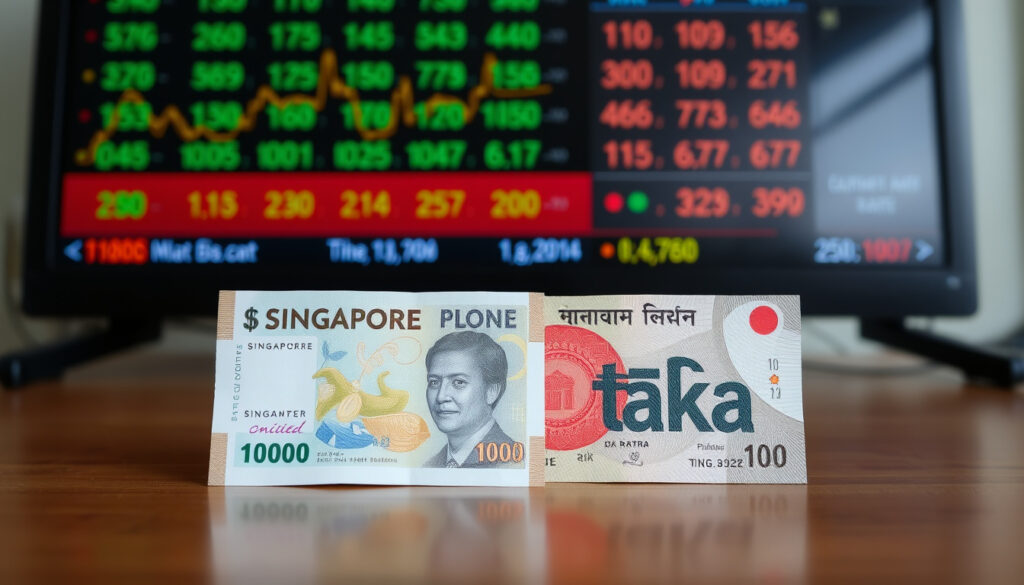
Singapore Dollar to Taka: Live SGD to BDT Conversion Rate
If you’re sending money from Singapore to Bangladesh or planning a trip, the exchange rate between the Singapore dollar and the Bangladeshi taka is something you’ll want to get right — and unlike the static numbers you see on search results, the real rate moves every day. This guide unpacks the live mid-market rate, shows what 1,000 SGD converts to, and explains why the Singapore dollar holds such strength against the taka.
1 SGD to BDT (mid-market): 96.98 BDT ·
1000 SGD to BDT: 96,989 BDT ·
SGD currency code: SGD ·
BDT currency code: BDT ·
Singapore currency name: Singapore dollar ·
Bangladesh currency name: Bangladeshi taka
Quick snapshot
- Singapore dollar (SGD) is the official currency of Singapore (Monetary Authority of Singapore).
- Bangladeshi taka (BDT) is the official currency of Bangladesh (Bangladesh Bank).
- 1 SGD ≈ 96.98 BDT at mid-market (MyCurrencyTransfer).
- SGD ranks among the top five strongest currencies in Asia (XE).
- Exact rate at any moment varies by provider (e.g., Wise shows 95.58 BDT, Ria shows 96.44 BDT) (Wise; Ria).
- Future exchange rate direction depends on global economic factors (Bangladesh Bank).
- Wise historical data shows 1 SGD = 94.16 BDT on 22 October 2025 (Wise).
- Bangladesh Bank updates its inter-bank rate table daily (last update: 3 September 2026) (Bangladesh Bank).
Here’s the essential profile of both currencies at a glance.
| Label | Value |
|---|---|
| Official name | Singapore dollar (SGD) |
| Symbol | S$ |
| Mid-market rate (1 SGD to BDT) | 96.98 BDT |
| Common remittance services | Wise, Western Union, Ria |
| Bangladeshi taka code | BDT |
| SGD strength rank in Asia | Among top 5 strongest |
How much is $1 dollar in Singapore in Bangladeshi Taka today?
Current mid-market rate for 1 SGD to BDT
- As of the latest data, the mid-market rate for 1 SGD equals approximately 96.98 BDT, according to MyCurrencyTransfer.
- Other providers report slightly different numbers: XE shows 95.59 BDT, while Ria lists 96.44 BDT.
- Rates fluctuate daily and vary by service provider.
The pattern: the spread between providers can be as wide as 1 BDT per SGD, which adds up on larger transfers.
How to get live rate for SGD to BDT
- Use Wise or XE for real-time mid-market rates.
- Check Bangladesh Bank for the official inter-bank rate (updated each working day).
- Remember that the rate you actually get will include a margin — always compare before transferring.
The pattern: the mid-market rate is a reference point, not a guarantee — the rate you’re offered is the one that matters.
How much is 1000 Singapore dollars in Bangladeshi taka?
Conversion table for common SGD amounts to BDT
One thousand SGD at mid-market converts to 96,989 BDT, but the table below shows how the numbers scale across typical amounts.
| SGD amount | BDT equivalent (mid-market) | Source |
|---|---|---|
| 1 SGD | 96.98 BDT | MyCurrencyTransfer |
| 10 SGD | 969.83 BDT | Ria |
| 100 SGD | 9,698.93 BDT | Ria |
| 1,000 SGD | 96,989.30 BDT | Ria |
The catch: the rates above are mid-market. Remittance services add a fee margin that typically reduces the amount received by 1–3%.
Fees and rate differences for remittance
- Wise charges a transparent fee and uses the mid-market rate, making it a popular choice for transfers.
- Western Union and Ria often offer less favorable rates but may have lower fees for small amounts.
- Always compare the total cost: rate + fee = real exchange rate.
For a remittance of 1,000 SGD, choosing a service with a mid-market rate instead of a bank’s marked-up rate can save the recipient as much as 5,000 BDT — enough to cover a week’s groceries in Dhaka.
What this means: a one-taka difference in the rate changes the final payout by 1,000 BDT for every 1,000 SGD sent.
What is the name of Singapore’s currency?
Singapore dollar (SGD) official name and symbol
- The official name is the Singapore dollar, abbreviated as SGD (Monetary Authority of Singapore).
- Its symbol is S$, though it is often simply written as SGD.
Bangladeshi taka (BDT) official name and symbol
- The Bangladeshi taka (BDT) is the currency of Bangladesh, issued by Bangladesh Bank.
- Its symbol is ৳ or Tk.
The pattern: both currencies use a three-letter ISO code — SGD and BDT — making international transactions straightforward.
Is Singapore a strong currency?
Factors that make SGD a strong currency
- SGD is considered one of the strongest currencies in Asia, backed by Singapore’s stable economy and robust monetary policy (Monetary Authority of Singapore).
- The currency benefits from low inflation (around 2–3%) and a strong trade surplus.
Comparison with other regional currencies
- Against the Bangladeshi taka, 1 SGD buys roughly 97 BDT, reflecting the large gap in economic size and stability.
- Compared to the Indonesian rupiah or Philippine peso, SGD also trades at a high multiple (XE).
For Bangladeshi workers in Singapore, the strong SGD means their earnings convert to a much larger amount in taka — a 1,000 SGD salary is worth nearly 97,000 BDT, significantly outpacing local wages in Bangladesh.
What this means: SGD’s strength against BDT is not a market anomaly; it reflects two economies at very different stages of development.
Why is Singapore dollar high?
Economic stability
- Singapore’s economy is driven by finance, trade, and technology, with a GDP per capita among the highest in the world (Monetary Authority of Singapore).
- Political stability and strong rule of law attract foreign investment, supporting the currency.
Monetary Authority of Singapore policy
- The MAS manages the SGD through a managed float system, allowing gradual appreciation over time (Monetary Authority of Singapore).
- This policy keeps inflation low and ensures the currency remains strong relative to regional peers.
Low inflation and strong trade surplus
- Singapore consistently runs a trade surplus, creating demand for SGD from foreign buyers of its goods and services (Singapore Department of Statistics).
- High foreign reserves (over $400 billion USD) provide a buffer against external shocks.
The implication: the Singapore dollar’s strength is not accidental — it’s the result of deliberate policy choices and structural economic advantages that are unlikely to change in the near term.
Comparing SGD to BDT rates across providers
Five providers, five different rates — here’s how they stack up for a 1 SGD conversion.
| Provider | Mid-market rate (1 SGD → BDT) | Notes |
|---|---|---|
| Wise | 95.58 | Transparent fee, mid-market rate |
| XE | 95.59 | Real-time rate, used for reference |
| Ria | 96.44 | Mid-market rate, but transfer fees apply |
| Pluang | 96.92 | Updated 2 Sep 2026 |
| MyCurrencyTransfer | 96.98 | Mid-market rate, comparison tool |
The pattern: the spread between the lowest and highest mid-market rate is about 1.4 BDT per SGD — on a 1,000 SGD transfer, that’s a 1,400 BDT difference before fees.
Confirmed facts and what’s unclear
Confirmed facts
- 1 SGD equals approximately 96.98 BDT as of latest data (MyCurrencyTransfer).
- Singapore dollar is stronger than Bangladeshi taka (XE).
- MAS manages SGD through a managed float (Monetary Authority of Singapore).
What’s unclear
- Exact rate at any specific moment varies by provider (Wise; Ria).
- Future exchange rate direction depends on global economic factors (Bangladesh Bank).
- Provider quotes can differ by more than 1 BDT per SGD, so the exact delivered rate depends on the service and the moment you transact (Wise; Ria).
The distinction matters: confirmed facts are the floor you can rely on; the unclear items are where the quoted rate can move against you.
Expert perspectives
“The Monetary Authority of Singapore operates a managed float exchange rate system, which allows the Singapore dollar to appreciate gradually against other currencies. This policy has been a key factor in maintaining the currency’s strength and low inflation.”
“The mid-market rate is the midpoint between the buy and sell prices of a currency pair in global markets. It’s the fairest rate — but most banks and transfer services will add a margin on top.”
XE (currency data provider)
The practical takeaway: central bank policy explains why SGD is strong, and XE’s definition explains why the rate you get differs from the mid-market benchmark — compare both before you transfer.
Summary
Whether you’re a Bangladeshi worker in Singapore sending remittances or a traveler planning a trip, the Singapore dollar to taka rate is a moving target. The mid-market rate today sits around 96.98 BDT per SGD, but what you actually get depends on the provider you choose and the fees they charge. For a Bangladeshi worker sending 1,000 SGD home, the choice is clear: use a transparent service like Wise to maximize the taka received, or accept a bank’s marked-up rate — and lose enough to cover a week’s groceries.
Related reading: Singapore Dollar Rate in Bangladesh – Latest Mid-Market Rates & Comparisons · Bangladesh Bank Official Exchange Rate Table
currencyexpert.com, pluang.com, monito.com, wise.com, transfergo.com
Frequently asked questions
How do I convert Singapore dollars to Bangladeshi taka?
Use an online currency converter like XE or Wise to get the mid-market rate. Multiply the SGD amount by the rate to get the BDT equivalent. For actual transfers, compare the total cost (rate + fees).
What is the best way to send money from Singapore to Bangladesh?
Wise offers the mid-market rate with a low, transparent fee, making it a strong option. Western Union and Ria are alternatives but often have less favorable rates.
Does the exchange rate change during weekends?
Currency markets are closed on weekends, so mid-market rates typically remain static from Friday evening to Monday morning. However, some providers may still update their rates based on the last known market price.
Are there any fees when converting SGD to BDT?
Yes, most services charge a fee or add a margin to the exchange rate. Wise charges a percentage fee, while banks often hide the margin in the rate. Always check the total cost before transferring.
Can I use Singapore dollars in Bangladesh?
No, SGD is not accepted as legal tender in Bangladesh. You must convert SGD to BDT at a bank, currency exchange, or through a remittance service.
What is the difference between mid-market rate and bank rate?
The mid-market rate is the wholesale rate used by banks and large institutions. Banks typically offer a less favorable rate to individual customers, adding a markup of 2–5%.
If you’re comparing providers, start with the mid-market rate, then add the fee — the cheapest advertised rate is rarely the cheapest delivered rate.
More related posts
 Ferry Ticket to Bintan 2026: Prices, Booking & Tips
 Bao Shi Fu Singapore: Menu, Prices, Reviews & Outlets (2025)
 AK721 Security Issue: What Happened at Changi Airport
 Li Bai Cantonese Restaurant: Family Guide & Reviews Singapore
 Car Crash at Geylang Pasar Malam: What Happened and Safety Tips
 Go-to-Market Strategy – Components Framework and Steps
 Bread Street Kitchen Reviews: Is It Worth It? (2025 Guide)