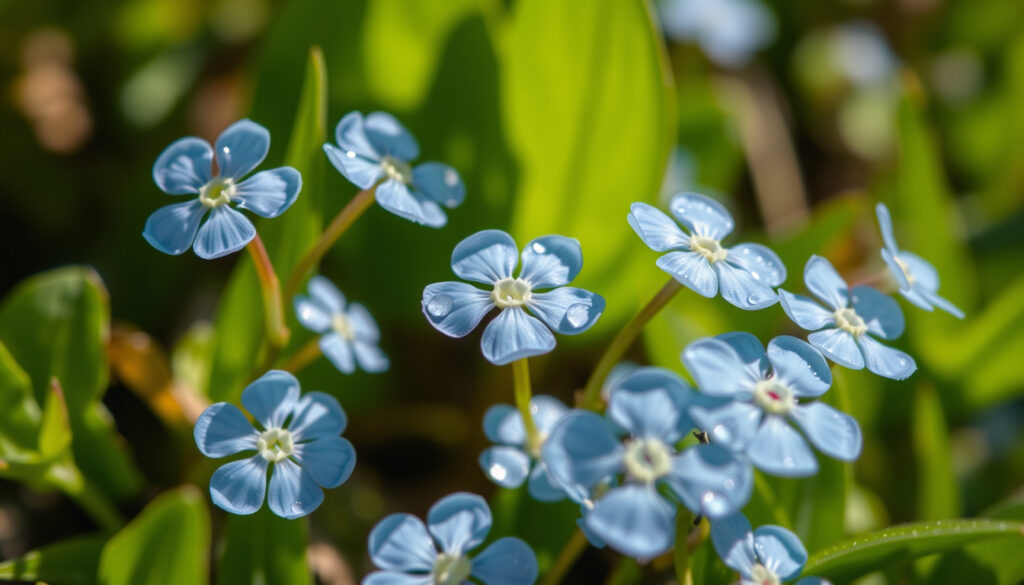
Forget Me Not Flower: Meaning, Growing and Care Tips
Anyone who has ever been handed a forget-me-not knows the flower arrives with a quiet instruction: remember. That tiny blue bloom has been doing the job for a remarkably long time — the English name was already in use by the mid-1500s — and it now carries meanings that stretch from medieval love tokens to Alzheimer’s awareness campaigns. Planting one in your own garden is easy once you know a few basics about soil, light, and its habit of self-seeding (Farmers’ Almanac (home gardening reference)).
Scientific name: Myosotis ·
Hardiness zones: 3–8 ·
Bloom season: Spring to early summer ·
Height: 6–12 inches (15–30 cm) ·
Light requirement: Partial shade to full sun
Quick snapshot
- Forget-me-not is the common name for plants in the genus Myosotis — from the Greek for “mouse’s ear” (Wikipedia’s Myosotis entry (botanical reference)).
- Water forget-me-not (Myosotis scorpioides) is a true perennial that grows in wet soil at pond margins or in water up to 10 cm deep (Royal Horticultural Society (UK gardening authority)).
- The exact origin of the common name is debated; the drowning-knight story is legend rather than verified history (The Met Cloisters garden blog (museum archive)).
- Lifespan varies by species: field forget-me-not (Myosotis arvensis) is a hairy annual or biennial native to Eurasia and northwest Africa (Michigan State University invasive species network (regional plant monitoring)).
- Traditional herbal uses rest on limited modern evidence. (The Met Cloisters garden blog (museum archive))
- According to Wikipedia’s Myosotis entry, the flower became an emblem of the Grand Lodge Zur Sonne at its 1926 convention in Bremen, Germany (Wikipedia’s Myosotis entry (botanical reference)).
- Sow seeds in late spring to early summer for blooms the following year.
- Transplant nursery plants in autumn or early spring for a quicker first-season show.
- Expect self-seeded seedlings to fill bare gaps by the second year.
Seven growing facts, one pattern: give forget-me-nots damp soil, dappled light, and a little room to self-seed, and they’ll bloom from April to June with minimal fuss.
| Factor | Detail |
|---|---|
| Scientific name | Myosotis (genus) |
| Family | Boraginaceae |
| Bloom time | Spring to early summer (April–June) |
| Light | Partial shade to full sun |
| Soil | Moist, well-drained, rich in organic matter |
| Hardiness | USDA zones 3–8 |
| Toxicity | Non-toxic to humans and pets |
Why is it called ‘forget me not flower’?
The most repeated backstory is a German folktale that has been told since the 15th century: a knight walks a riverbank gathering flowers for his lady, loses his footing, and as the current pulls him under, he tosses the bouquet to shore and shouts, “Forget me not.” It is a lovely story, and most plant references tell it with a wink — nobody has ever produced a coroner’s report.
The documented history is just as colorful. The English name was borrowed from Old French and was in use by the mid-1500s; the flower appears in 15th-century works by Rogier van der Weyden, Stefan Lochner, Vittore Carpaccio, and Luca Signorelli; and Henry Bolingbroke, later King Henry IV, adopted the little bloom as his personal emblem. The drowning-knight tale, by contrast, is presented as legend rather than verified history (The Met Cloisters garden blog (museum archive)).
What flower symbolizes dementia?
- The flower’s core symbolism — remembrance, faithful love, fidelity, and enduring connection — was already embedded in medieval art, and that “remember me” quality is exactly why the plant was later adopted by the dementia-awareness movement.
- The Alzheimer’s Association describes the forget-me-not as the official flower of Alzheimer’s awareness, chosen for its name and lasting blue color.
- In practice, the flower shows up on pin badges, awareness banners, and memorial plantings for dementia organizations.
What is forget me not good for?
- In herbal tradition, the plant was used for lung ailments and as a mild astringent, though modern use is minimal.
- No reliable clinical evidence supports those traditional uses; today the forget-me-not is grown almost entirely as an ornamental.
- In the garden, its real job is structure: it fills shady gaps, edges paths, and naturalizes under trees.
A flower that stood for faithful love in 15th-century courts now carries the memory of dementia patients in awareness campaigns — the name did that work across six centuries.
What do forget-me-not flowers look like?
Forget-me-not blooms are small — about 1 cm across — with five petals and a bright yellow or white eye. The classic color is sky blue, though pink, white, and purple forms exist, and the leaves are alternate, lance-shaped, and softly hairy (Wikipedia’s Forget-me-not entry (botanical reference)).
That clear, true blue is part of why the plant is so recognizable, even from across a garden bed.
What do forget-me-nots look like when they first start to grow?
- Seedlings appear as small rosettes of rounded, hairy leaves that hug the ground.
- The flowering stalk rises later, reaching about 6–12 inches (15–30 cm).
- At the seedling stage, the fuzzy foliage is the best clue: most garden weeds don’t have forget-me-not’s soft, hairy rosette.
What this means: once you recognize the rosette and the hairy leaf, you’ll spot young forget-me-nots long before they bloom — and you’ll stop pulling them out as weeds.
How long does ‘forget me not bloom’ last?
In temperate gardens, the bloom period usually runs from April through June, and individual flowers hold for roughly four to six weeks.
Do forget-me-not come back every year?
- Most garden forget-me-nots are short-lived perennials or biennials: they don’t reliably return from the same root.
- They self-seed so freely that the planting refills itself — the blue patch you loved in June will usually be back next spring, grown from its own seed.
- Woodland forget-me-not (Myosotis sylvatica) often acts as a true biennial: leaves in year one, flowers in year two, then seed and die.
- Water forget-me-not (Myosotis scorpioides) is the exception — a genuine perennial for moist soil and pond edges.
The plant that “comes back every year” is usually the next generation. Let a few flower stems go to seed and you effectively buy yourself a permanent patch.
The trade-off: you get dependable yearly color only if you resist the urge to deadhead everything and leave some seeds to fall.
Where is the best place to plant forget-me-nots?
Site choice matters more than almost anything else. Forget-me-nots are forgiving about soil texture and pH, but they are not forgiving about dryness: water forget-me-not grows in wet soil at pond margins or in water up to 10 cm deep, tolerates full sun to partial shade, and accepts clay, loam, or sand in acidic to alkaline conditions (Royal Horticultural Society (UK gardening authority)).
For the garden varieties most people grow, the practical translation: pick a spot with moist, well-drained soil rich in organic matter, ideally in partial shade with morning sun.
Can forget-me-nots be grown in pots?
- Yes. Use a loam-based potting mix and make sure the container has drainage holes.
- Keep the soil consistently moist; pots dry out faster than beds, so check them often in warm weather.
- Containers are a good option for shaded balconies and patios, and you can move pots to chase the right amount of sun.
What is the best time of year to plant forget-me-nots?
- Sow seeds outdoors in late spring to early summer for blooms the following year.
- Plant nursery-grown transplants in autumn or early spring for the quickest first-season show.
- In mild climates, an autumn sowing also works; the seedlings overwinter as small rosettes and flower in spring.
Is the forget-me-not flower easy to grow?
- Yes. Seeds germinate quickly, plants tolerate a range of soils, and the main task is keeping the soil from drying out.
- Once established, they need very little feeding and almost no pruning — just a haircut after bloom if you want to control self-seeding.
The implication: if you can keep soil damp and shelter the plants from harsh afternoon sun, you can grow forget-me-nots in borders, pots, or damp corners where other flowers refuse to go.
What plants go well with forget-me-nots?
- Spring bulbs are the classic partners: tulips and daffodils emerge at the same time, and the blue flowers knit the bed together after the bulb blooms fade.
- Shade-loving perennials such as primroses, ferns, and hostas share the same cool, moist conditions and create layered foliage.
- Along woodland edges and under trees, forget-me-nots weave into a natural-looking groundcover.
The ones to avoid: aggressive spreaders such as mint, and anything that demands dry soil — forget-me-nots will sulk if their roots bake.
The self-seeding habit that makes forget-me-nots effortless is the same trait that lands some species, like field forget-me-not, on invasive-plant monitoring lists in parts of North America.
The pattern: the best partners share the bed’s moisture and light, and leave enough open soil for forget-me-not seedlings to settle in.
How to Grow Forget-Me-Nots Step by Step
Once the site is chosen, the routine is short. These steps cover the full cycle, from seed to self-sustaining patch.
- Choose the right species. Woodland forget-me-not (Myosotis sylvatica) suits borders and shade beds; water forget-me-not (Myosotis scorpioides) suits pond margins, wet borders, and shallow water.
- Prepare the soil. Dig in compost or leaf mold so the bed holds moisture without waterlogging.
- Sow seeds in late spring to early summer. Scatter them on the surface and press them in lightly — the seeds need light to germinate — then water gently.
- Keep seedlings consistently moist. This is the step people skip; a dry week is the most common cause of seedling loss.
- Thin or transplant to about 6–8 inches (15–20 cm) apart. Healthy rosettes will fill the gaps by the following season.
- Propagate by seed or division. Sow seed in situ at pond margins or in moist compost in a cold frame in spring, or divide established clumps in spring (Royal Horticultural Society (UK gardening authority)).
What this means: following these steps creates a self-sustaining patch of blue that returns year after year.
What’s Confirmed and What’s Unclear
Confirmed facts
- The flower’s symbolism of remembrance and faithful love is documented in medieval art and heraldry (The Met Cloisters garden blog (museum archive)).
- Field forget-me-not (Myosotis arvensis) is native to Eurasia and northwest Africa and behaves as an annual or biennial (Michigan State University invasive species network (regional plant monitoring)).
- The genus Myosotis contains more than 100 species, and the name comes from the Greek for “mouse’s ear” (Wikipedia’s Myosotis entry (botanical reference)).
What’s unclear
- The exact origin of the common name is still debated; the drowning-knight story is widely told but sits firmly in legend.
- How a given plant behaves depends on species and climate: some are aquatic perennials, others upland biennials, so “does it come back?” has no single answer.
- The alpine forget-me-not is often described as Alaska’s state flower, but the documentation is mostly secondary.
- Traditional medicinal uses — lung ailments, a mild astringent — rest on limited modern evidence.
What this means: the name, the genus, and the medieval symbolism are solid; the legend and the lifecycle are not one-size-fits-all. Treat the stories as stories and the plants as adaptable, and you won’t go wrong.
What the Experts Say
Two voices matter for anyone growing or understanding this flower: the horticulturists who know its habits, and the advocates who adopted its name.
Forget-me-nots are undemanding plants that thrive in moist, shady conditions, making them ideal for woodland gardens and borders.
Royal Horticultural Society (UK gardening authority)
The forget-me-not is the official flower of Alzheimer’s awareness, chosen for its name and lasting blue color.
Alzheimer’s Association (dementia awareness organization)
The takeaway: gardeners get a low-maintenance bloom, and advocates get a flower that literally reads as a sentence — remember me. Both uses rest on the same petite blue petals.
The Takeaway
Forget-me-nots bridge two very different worlds: a documented history of medieval courtship and remembrance, and a practical present as one of the easiest spring flowers for damp, shady spots. They ask for moist soil, tolerance of their seed-setting habit, and not much else. For urban gardeners working with shaded balconies and small beds, the choice is clear: give the plant consistently moist soil and a spot out of harsh afternoon sun, or accept a shorter, more brittle bloom season.
Frequently asked questions
Are forget-me-nots invasive?
Some are. Field forget-me-not (Myosotis arvensis), a hairy annual or biennial native to Eurasia and northwest Africa, appears on invasive-species monitoring lists in parts of North America.
What colors do forget-me-not flowers come in?
Sky blue with a yellow or white center is the classic, but pink, white, and purple forms exist, and some blooms shift color as they age (see the appearance section above).
How do I collect forget-me-not seeds?
Let the flowers fade without deadheading. The tiny seeds mature in the dried flower clusters; shake the dry stems over an envelope or bag, then sow right away or store in a cool, dry place until late spring.
Can forget-me-nots grow in full sun?
Yes, as long as the soil stays moist. Full sun to partial shade both work; in hot climates, morning sun with afternoon shade gives the longest bloom.
Are forget-me-nots deer resistant?
Gardeners commonly report that deer leave them alone, likely because of the fuzzy, hairy foliage — but that’s anecdotal, not a guarantee. Treat “deer resistant” here as a hopeful “usually.”
How do I propagate forget-me-nots?
By seed or division. As covered in the growing steps, sow seed in spring — in place or in a cold frame — or divide established clumps in spring.
Related reading
For more from the same editorial team on gardens and nature:
More related posts
 Tsugaike Kogen Ski Resort: Beginners Guide, Access & Hakuba Comparison
 Secondary School Math Tuition: Costs & Tips
 Haidilao Jurong Point: Menu, Prices, Free Services & Booking
 CCC Certified Power Bank: Brands, Verification & Travel Tips
 Is Stomach Flu Contagious? Timeline & When to Isolate
 The Creek @ Bukit: Reviews, Price, Floor Plan & Maintenance Fee (2025)