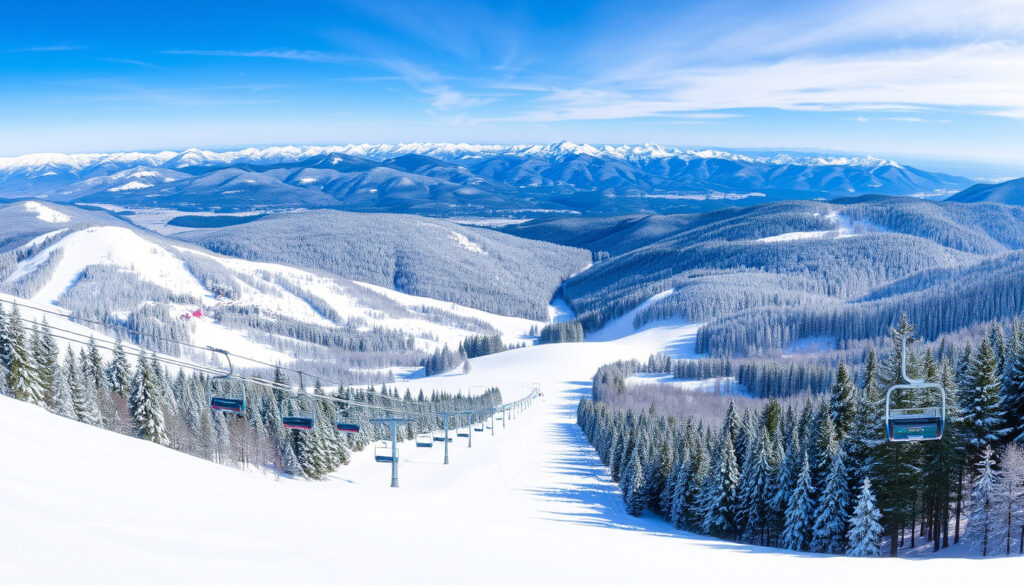
Tsugaike Kogen Ski Resort: Beginners Guide, Access & Hakuba Comparison
If you’ve ever watched someone cruise down a beginner slope with a grin while you struggled on a steeper run, you know the frustration of being mismatched with terrain. Tsugaike Kogen Ski Resort in Hakuba Valley solves that problem with unusual precision—its lower mountain was built for the exact moment when falling feels embarrassing and progress feels thrilling. This guide covers everything you need to know about Tsugaike, including how it compares to nearby Shiga Kogen and Hakuba, to help you land in the right place for your skill level.
Piste Area: 156 hectares · Vertical Drop: 900 meters · Number of Lifts: 15 · Annual Snowfall: 12 meters · Elevation Range: 800-1,704 meters
Quick snapshot
- 50% beginner terrain — the highest share in Hakuba Valley (Japan Ski Guide)
- 900m vertical drop across 156 hectares of piste (Japow Travel) (Japan Ski Guide)
- ¥7,200 one-day lift pass — the most affordable in the valley (Japow Travel) (Japan Ski Guide)
- Current lift operating status varies by season — check resort notices before visiting
- Exact opening and closing dates shift annually — no fixed ISO dates available
- Precise shuttle bus schedules from Tokyo lack consistent public documentation
- Hakuba hosted the 1998 Winter Olympics — shaping resort development across the valley (Japow Travel) (Hakuba.com)
- Backcountry gating at Tsugaike formalized recently with mandatory safety lectures (Hakuba.com)
- January through March remains the peak window for reliable powder at Tsugaike
- Shiga Kogen’s higher elevation advantage continues to grow as climate shifts snowfall patterns
Key specifications for Tsugaike Kogen at a glance, sourced from resort data.
| Label | Value |
|---|---|
| Location | Hakuba, Japan |
| Vertical Drop | 900m |
| Piste Area | 156 hectares |
| Lifts | 15 |
| Snowfall | 12m average |
| Beginner Rating | Top in Hakuba |
Is Tsugaike good for beginners?
Tsugaike Kogen earns its reputation as the best starting point for new skiers in Hakuba Valley through deliberate terrain design, not accident. Roughly half of all runs cater to beginners, with an even more striking claim from Wamazing that up to 80% of courses target beginners and intermediates combined. The resort’s lower mountain delivers exactly what that promise suggests: wide, gently angled slopes with an average incline around 8 degrees.
Base area slopes
The Kane-no-naru-oka Slope anchors Tsugaike’s beginner zone with wide, flat terrain that lets first-timers focus on technique rather than survival. A gondola and five short chairlifts shuttle beginners from the base without forcing them onto intimidating mid-mountain pitches. Simon Jack Burgess, who has documented Japan ski resorts extensively, describes the lower mountain as purpose-built for learning with mellow gradients and forgiving boundaries.
Variety of terrain
While beginners dominate the lower mountain, Tsugaike rewards progress with 30% intermediate and 20% advanced runs for when skills develop. The Uma-no-se Course provides the sharpest contrast — a mogul-filled black run with maximum 32-degree inclines that Wamazing identifies as the resort’s most demanding descent. This gradient from start to finish means a family can stay together longer here than at resorts that front-load advanced terrain.
For a first-time skier in Nagano Prefecture, Tsugaike removes the anxiety that steeper Hakuba runs create. Families with mixed abilities benefit most — children and hesitant adults get gentle terrain while stronger skiers venture toward the Uma-no-se Course without leaving the resort.
How easy is it to get to Tsugaike Kogen?
Accessing Tsugaike requires more planning than some Hakuba resorts, but the complexity is manageable once you know your options. Five airports serve the region, and Tokyo provides the most frequent departure points for skiers coming from outside Japan.
From nearby airports
Chubu Centrair International Airport (NGO) offers the most direct route for international visitors, with car rental and shuttle services connecting to Hakuba Valley in approximately 2.5 hours. Narita (NRT) and Haneda (HND) in Tokyo also serve the region, though travel times stretch to 4-5 hours depending on traffic and connections. Wamazing documents access routes from multiple departure points, though specific bus schedules lack consistent public documentation.
From Tokyo
The Shinkansen from Tokyo Station to Nagano Station takes roughly 1 hour 40 minutes on the fastest services, positioning Nagano as the primary rail hub for Hakuba Valley resorts. From Nagano Station, shuttle buses reach Tsugaike in approximately 45 minutes to 1 hour. Direct bus services from Tokyo also operate during peak season, though precise timetables shift annually and require confirmation before travel.
Shiga Kogen’s base elevation of 1,325m sits nearly 500 meters higher than Tsugaike’s starting point at 800m, which translates to colder temperatures and more reliable snow preservation during mid-season thaw periods. If your trip falls in February or March, that elevation gap becomes noticeable on the slopes.
How does Tsugaike compare to Hakuba?
Hakuba Valley encompasses 10 separate resorts, offering terrain variety that Tsugaike cannot match, but that breadth creates its own complications. For a beginner or early intermediate, navigating between Happo-one, Hakuba 47, and Goryu requires shuttle buses and careful planning that interrupts the skiing rhythm.
Terrain and crowds
The terrain breakdown tells the story clearly: Hakuba Valley allocates only 31% of its combined 129 courses to beginners, versus 50% at Tsugaike, according to Zen Trip. Advanced skiers get 38% of Hakuba’s terrain against just 20% at Tsugaike. For a group with mixed abilities, Tsugaike concentrates more of its skiable area in the learning zone, reducing the tension between faster and slower members.
Beginner suitability
The comparison becomes even starker when considering crowd patterns. Hakuba’s Olympic legacy and international reputation draw larger crowds during peak periods, which can overwhelm first-timers on narrow beginner runs. Tsugaike’s more local character means shorter lift queues on the beginner terrain even during school holidays. Zen Trip notes that Tsugaike tailors itself to mixed groups where beginners need confident progression without constant collision with faster traffic.
If advanced terrain variety matters to your group more than beginner comfort, Hakuba delivers more black runs and steep pitches per resort. But if anyone’s first day on snow is in your party, the lower mountain at Tsugaike will feel like it was designed for that specific person — because it largely was.
Which is better Hakuba or Shiga Kogen?
This comparison involves two fundamentally different resort philosophies, and the answer depends heavily on what you value most in a ski trip. Japow Travel frames Shiga Kogen as the safer bet for consistent surfaces, while Hakuba appeals to those seeking hero-day terrain.
Altitude and vibe
Shiga Kogen’s 18 interconnected areas span 425 hectares with a vertical drop of 980m, topping out at 2,307m where snow quality remains reliable even when lower bases soften, according to Japow Travel. Hakuba reaches only 1,831m at its highest point but offers more dramatic vertical relief in specific resorts. The elevation gap means Shiga Kogen typically preserves powder conditions longer into each day and across the season.
Village presence
Shiga Kogen lacks the dense village atmosphere of Hakuba, with accommodation spread across mountain zones rather than concentrated in a single pedestrian-friendly base. Japow Travel describes Shiga’s appeal as a more traditional Japanese ski experience, heavy on onsen culture and domestic visitors, while Hakuba delivers international dining and vibrant après-ski scenes that Zen Trip attributes to its Olympic legacy.
What month is best to ski in Japan?
January through March represents the optimal window for most Nagano resorts, including Tsugaike. This period balances reliable snowfall, manageable temperatures, and longer daylight hours that let skiers maximize slope time.
Peak snow months
February typically delivers the deepest base depths across the Nagano region, with consistent overnight accumulations and minimal thaw cycles. March offers excellent conditions as well, particularly at higher elevations where Shiga Kogen’s 2,307m summit maintains cold temperatures while lower bases like Tsugaike’s 800m may see occasional warm spells. Japow Travel confirms snowfall averages around 10-11 meters annually across the Hakuba and Shiga Kogen regions, providing ample material for the December through March window.
Tsugaike specifics
Tsugaike’s lower base elevation means it responds more quickly to warmth than Shiga Kogen, making early-season December visits and late-season March trips more dependent on recent snowfall than at higher resorts. The 12-meter annual snowfall figure Japow Travel cites refers to accumulation over the full season — mid-season conditions typically exceed early and late season quality regardless of the calendar month.
If your trip falls in early December or late March, Shiga Kogen’s elevation advantage becomes significant. Tsugaike will still offer enjoyable conditions if recent snow has fallen, but Shiga Kogen’s higher base provides more margin for error when temperatures fluctuate.
Tsugaike Kogen at a glance
Three resorts, three different propositions for Nagano skiers. Tsugaike prioritizes the learning experience; Hakuba offers variety and international infrastructure; Shiga Kogen delivers scale and snow reliability at altitude.
Direct price comparison reveals Tsugaike as the most budget-friendly option in the valley.
| Metric | Tsugaike Kogen | Hakuba Valley | Shiga Kogen |
|---|---|---|---|
| Vertical Drop | 900m | Up to 1,071m | 980m |
| Piste / Skiable Area | 156 ha | 10 resorts | 425 ha connected |
| Ski Areas | 1 main area | 10 resorts | 18 areas |
| Beginner Terrain | 50% | 31% | 40% |
| Advanced Terrain | 20% | 38% | 24% |
| 1-Day Lift Pass | ¥7,200 | ¥10,400 | ¥9,000 |
| Base Elevation | 800m | 760m | 1,325m |
| Summit Elevation | 1,704m | 1,831m | 2,307m |
| Annual Snowfall | 12m | ~11m | ~10m |
Tsugaike’s ¥7,200 one-day lift pass stands out as the most affordable option among the three areas. Hakuba’s ¥10,400 represents the premium pricing tier, while Shiga Kogen at ¥9,000 occupies the middle ground.
Pros and cons
Upsides
- 50% beginner terrain — highest proportion in Hakuba Valley
- ¥7,200 daily pass — most affordable major resort in the region
- Family-friendly with multilingual ski schools
- On-site Tsuga-no-yu hot spring for post-slope relaxation
- Backcountry access available via gates with safety lecture
Downsides
- Lower base elevation (800m) than Shiga Kogen — less snow reliability in early/late season
- Single resort area — less terrain variety than Hakuba’s 10 resorts
- Access requires more planning than resorts with direct Shinkansen stops
- 20% advanced terrain means limited challenge for expert skiers
Planning your Tsugaike visit
Practical steps for reaching and skiing Tsugaike Kogen, from transport to first runs on the lower mountain.
- Book accommodation near Tsugaike base or in Hakuba village — shuttle connections exist but advance reservation helps during peak season
- Take the Shinkansen to Nagano Station (from Tokyo: ~1 hour 40 minutes), then catch a shuttle bus to Tsugaike (45-60 minutes)
- Purchase the ¥7,200 one-day lift pass at the base ticket office before heading to the gondola
- Start on the Kane-no-naru-oka beginner slopes — wide, gentle terrain accessed by the gondola without crossing any difficult runs
- Progress to the five short chairlifts on the lower mountain once comfortable with the gondola descent
- Consider the Tsuga-no-yu hot spring after your first day — facilities are on-site and provide natural muscle relaxation
Tsugaike’s lower mountain delivers an exceptionally gentle learning environment, but that same characteristic limits what advanced skiers can experience without leaving the resort. If your group includes experts who need challenging terrain, plan a day trip to Happo-one in Hakuba Valley for steeper pitches — but expect to navigate between different facilities.
What we know and what remains unclear
Verified facts anchor the core picture: Tsugaike Kogen has 50% beginner terrain according to Japan Ski Guide, a 900m vertical drop from Japow Travel, and a summit elevation of 1,704m from Japan Ski Guide. The resort’s reputation as Hakuba’s most beginner-friendly option holds across multiple independent sources.
Gaps persist in specific operational details. Current lift status varies by season and requires checking resort announcements directly. Shuttle bus schedules from Tokyo lack consistent public documentation, making advance planning essential. Exact opening and closing dates shift annually without fixed ISO dates that travelers can rely on for long-term booking.
What experts say
“Tsugaike is tailor-made for mixed groups. Beginners and cruisy intermediates get some of Japan’s best learning terrain.”
— Japow Travel (Ski review publication)
“It’s one of the most beginner-friendly ski resorts in Japan, with about 80% of its courses geared towards beginners and intermediate-level skiers.”
— Wamazing (Travel media covering Japan ski destinations)
“Shiga Kogen is the safer answer for people who care less about hero days and more about consistent surfaces.”
— Japow Travel (Ski review publication)
For a beginner or family arriving in Nagano Prefecture for their first ski trip, the decision between Tsugaike, Hakuba, and Shiga Kogen ultimately comes down to one question: are you optimizing for the learning experience or for maximum terrain variety? Tsugaike wins the first category decisively — its concentrated beginner terrain, affordable ¥7,200 lift pass, multilingual schools, and on-site hot spring create an environment where first-timers can progress without the anxiety that steeper Hakuba runs or the navigation complexity of Shiga Kogen’s sprawling 18-area network create. Book early for peak-season accommodation, confirm shuttle schedules before arrival, and accept that some advanced terrain will require a day trip elsewhere — because the lower mountain at Tsugaike will deliver exactly what a nervous beginner needs: space to fall, learn, and improve without embarrassment.
Related reading: How to Check if Product is HSA Approved: Singapore Guide
snowmonkeyresorts.com, japow.travel, tripadvisor.com, mountainwatch.travel, travel.gaijinpot.com, snowjapan.com
Frequently asked questions
Is Shiga Kogen a good ski resort?
Yes. Shiga Kogen is Japan’s largest interconnected ski area with 18 zones covering 425 hectares, offering superior powder reliability due to its high base elevation of 1,325m. The 980m vertical drop and 83 courses cater to all skill levels, though the lack of a concentrated village base makes navigation less intuitive than smaller resorts.
Does Shiga Kogen have a town?
Shiga Kogen lacks a traditional single-village base. Accommodation spreads across mountain zones rather than concentrating in a pedestrian-friendly town center. The resort provides a more traditional Japanese ski experience focused on onsen culture and natural surroundings, but visitors expecting Hakuba’s international village atmosphere may find the layout disorienting at first.
Are there English speakers at Tsugaike Kogen?
Yes. Tsugaike Kogen has multilingual ski schools operating at the resort, and the area around Hakuba Valley generally accommodates English-speaking visitors better than more remote Japanese ski destinations. However, English signage and staff availability may be limited compared to larger international resorts.
What are Tsugaike Kogen Ski resort lift ticket prices?
The one-day lift pass costs ¥7,200 according to Japow Travel. This makes Tsugaike the most affordable major resort in the Hakuba Valley region, undercutting Hakuba’s ¥10,400 daily pass and Shiga Kogen’s ¥9,000 pass. Multi-day packages may offer discounts.
When does Tsugaike Kogen Ski Resort open?
Opening dates vary annually and depend on snowfall conditions. Peak ski season runs from January through March, when base depths reach their maximum. Exact opening and closing dates shift without fixed ISO dates available in current documentation — check the resort’s official announcements before planning late December or late March trips.
What is Tsugaike Kogen ski resort map like?
The resort features a single main ski area with terrain concentrated on the lower mountain for beginners. A gondola accesses the upper area, with five short chairlifts serving the beginner zone on the lower slopes. The layout is simpler than Hakuba’s dispersed 10-resort valley or Shiga Kogen’s 18 interconnected areas, making navigation straightforward for first-time visitors.
What do Tsugaike kogen ski resort reviews say?
Reviews consistently praise Tsugaike for its beginner-friendly terrain, affordable lift pass pricing, and family-friendly atmosphere. Japow Travel describes it as “tailor-made for mixed groups” while Wamazing highlights the resort’s concentration of beginner and intermediate runs. Common critiques include limited advanced terrain and access complexity compared to resorts with direct Shinkansen connections.
More related posts
 How to Get from Hanoi to Halong Bay: Costs, Time & Tips 2026
 Guangzhou Weather by Month: Best Time, Temps & Rain
 StarHub Prepaid Top Up: How to Add Credit Online & App Guide
 US to UK Shoe Size – Charts for Men, Women & Kids
 Food Court Near Me – Philadelphia Maps, Hours & Locations
 Galaxy S25 Plus to Buy: Which Model Is Best? (2025 Guide)
 2000 SGD to USD – Current Rate, History and Exchange Tips
 Singapore to Shenzhen Flight Time: Direct Flights & Tips