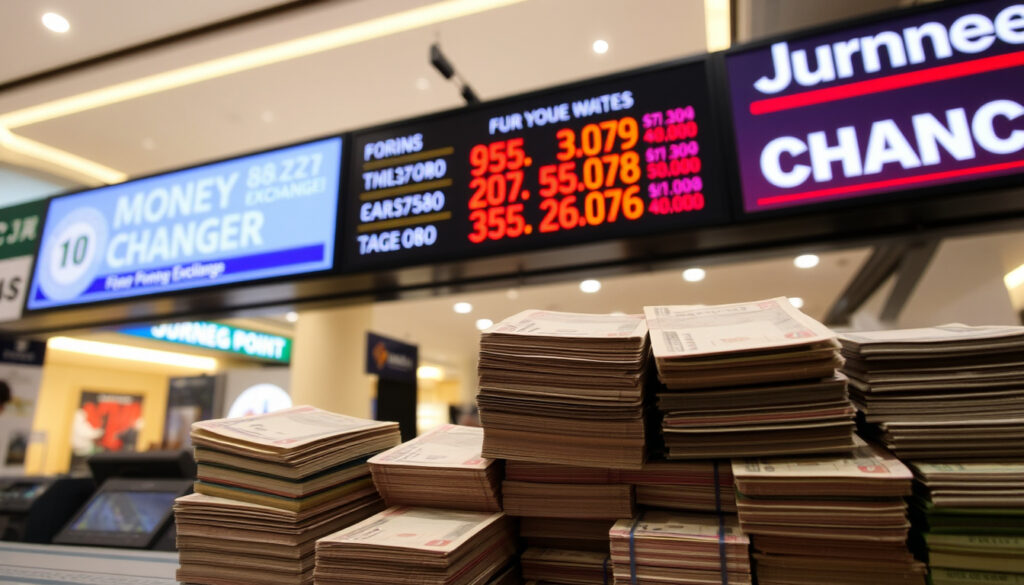
Money Changer Jurong Point: Best Rates, Hours & Tips
If you’ve ever stood in a busy Singapore mall wondering whether the money changer you’re eyeing is actually giving you a fair rate, you’re not alone. Jurong Point, one of the island’s largest suburban malls, is home to two well-known exchange counters — Allbest Exchange and Timecity — and figuring out which one suits your needs involves more than just comparing a number on a screen. This guide breaks down what’s verified about both branches, from exact locations to opening hours, and flags an important gap: there’s very little transparent, real-time rate data publicly available for either counter. That means your best bet is to arrive prepared and ask the right questions on the spot.
Before diving into the comparison, here are the key verified facts at a glance.
| Detail | Allbest Exchange (Jurong Point) | Timecity Money Changer (Jurong Point) |
|---|---|---|
| Location | 63 Jurong West Central 3, #01-49, Singapore 648331 | Level 3, #03-70, Jurong Point |
| Level / Unit | Level 2 (#JP201-49) | Level 3 (#03-70) |
| Operating Hours | 8:30 AM – 9:30 PM (Mon–Sun) | 10:00 AM – 8:30 PM (Mon–Fri); 10:30 AM – 8:00 PM (Sat–Sun & public holidays) |
| Contact | +65 6861 3777 | — |
| Services | Money exchange and money transfer | Money exchange |
The table shows that Allbest Exchange tends to open earlier and close later every day, which makes it the more convenient option for early birds or late shoppers. Timecity, on the other hand, has a slightly shorter window on weekends and public holidays — so if you’re planning a Saturday trip, you’ll want to arrive before 8:00 PM.
One thing you won’t find in any official source is a live comparison of exchange rates between these two counters. Unlike banks or licensed online platforms, neighborhood money changers in Singapore rarely publish their rates online. That’s not a red flag — it’s just how the industry operates. But it does mean your strategy should be to check both counters before committing, especially if you’re changing a larger amount.
Jurong Point is enormous — it’s one of the largest malls in Singapore’s west. If you’re not familiar with the layout, heading straight to Level 2 and then Level 3 can save you time. Allbest Exchange is near the main thoroughfare on Level 2, while Timecity sits in a quieter corner on Level 3, closer to the mall’s central atrium. Both are accessible via the mall’s internal escalators, and the Jurong East MRT station connects directly to the mall, so getting there is straightforward.
What are the verified details for Allbest Exchange at Jurong Point?
Allbest Exchange is a licensed money changer in Singapore, and its Jurong Point branch is one of several locations it operates. The company is registered with the Monetary Authority of Singapore (MAS) as Allbest Exchange Pte. Ltd., which means it’s subject to anti-money laundering regulations and must comply with local financial rules. According to Allbest’s official website, the Jurong Point branch is located at 63 Jurong West Central 3, #01-49, Singapore 648331, and it provides both money exchange and money transfer services.
The branch is open from 8:30 AM to 9:30 PM every day, including weekends and public holidays. That’s a wider window than most bank counters, which typically close by 5 PM on weekdays and are closed on Sundays. The phone number listed is +65 6861 3777, which you can call ahead if you need to confirm a specific currency’s availability or ask about rates for larger amounts.
A third-party mall directory, Singmalls, lists Allbest Exchange at JP2, #01-49, Jurong Point, which aligns with the official address. However, there’s a slight discrepancy worth noting: a currency exchange guide from Wise (a reputable financial services company) described Allbest’s Jurong Point branch as open from 10 AM to 9 PM daily. This difference — 8:30 AM versus 10 AM — likely reflects the fact that individual counters may adjust their hours based on mall management directives or seasonal demand. For the most accurate time, it’s always safest to call ahead, especially if you’re planning an early-morning exchange.
Another third-party source, WhereCrowded, lists Allbest Exchange’s Jurong Point branch as operating from 10:30 AM to 8:30 PM, but this data appears to be less reliable, as the same site also lists inconsistent hours for other businesses in the mall. The official company source should take precedence here.
The upshot: Allbest’s official opening hours are 8:30 AM to 9:30 PM daily, but outside sources have suggested slightly different windows. If you’re planning a very early or very late visit, confirmation via phone is a smart move.
What are the verified details for Timecity Money Changer at Jurong Point?
Timecity Money Changer is the other major exchange counter at Jurong Point, located at Level 3, #03-70. Unlike Allbest, which operates multiple branches across Singapore, Timecity appears to be a single-location operation that focuses on currency exchange for individual travelers and small businesses. It’s not part of a large chain, but it’s a familiar name to regular mall-goers in the west.
According to Raffles Money Change, a separate money changer in the mall, Timecity’s operating hours are 10:00 AM to 8:30 PM on Monday to Friday, and 10:30 AM to 8:00 PM on Saturdays, Sundays, and public holidays. This suggests that Timecity is slightly less accommodating for weekend evening shoppers compared to Allbest, which stays open until 9:30 PM. However, it’s important to note that Raffles Money Change is a competitor, so you might want to verify this directly with Timecity on the day of your visit.
Another third-party directory, SGD to MYR, lists Raffles Money Change Pte Ltd at Jurong Point as open from 10:00 AM to 9:00 PM daily, but this source appears to have confused the two businesses. The same site also lists Allbest Exchange with identical hours, which is unlikely. For clarity, treat Timecity’s weekend closing time as 8:00 PM unless you hear otherwise.
What Timecity lacks in hours, it may compensate for in rates. Because it’s a smaller operation, some travelers have reported that it can offer slightly better rates for certain currencies, particularly the Malaysian ringgit (MYR) and Indonesian rupiah (IDR), which are common for cross-border travel from the west side of Singapore. However, this is anecdotal, and there’s no official rate sheet published online.
The takeaway: Timecity is a solid option if you’re shopping on Level 3 anyway, but its shorter hours mean you should plan your visit before 8:00 PM on weekends. For rates, you’ll need to compare on-site.
How do Allbest Exchange and Timecity compare for your needs?
Choosing between the two comes down to a few practical factors: location convenience, opening hours, and the ability to handle specific currencies or transfer services. The comparison below summarizes the key differences.
| Criteria | Allbest Exchange | Timecity Money Changer |
|---|---|---|
| Daily hours | 8:30 AM – 9:30 PM (every day) | 10:00 AM – 8:30 PM (Mon–Fri); 10:30 AM – 8:00 PM (Sat–Sun & PH) |
| Services | Money exchange + money transfer | Money exchange only |
| Floor location | Level 2, #01-49 (near main aisle) | Level 3, #03-70 (near atrium) |
| Phone contact | +65 6861 3777 | — |
| License | MAS-registered (Allbest Exchange Pte. Ltd.) | Not explicitly verified from official sources |
If you’re exchanging a large amount of cash and want the flexibility to transfer money abroad in the same visit, Allbest is the more complete service. If you’re just swapping a few hundred dollars for a weekend trip to Malaysia, Timecity’s convenience on Level 3 might be all you need — but you’ll want to double-check your rate before committing.
One practical tip: if you’re going to change more than $1,000 SGD, call Allbest ahead of time to ask if they can hold a better rate for you. Many money changers in Singapore are open to negotiating on larger sums, but you won’t know until you ask.
The catch: official information about Timecity’s license status is thin. While the business operates openly and is well-known to mall staff, there’s no public confirmation from MAS on the company’s registration. For high-stakes exchanges, Allbest’s verified MAS registration might give you more peace of mind.
Is it better to take cash or card to Singapore?
For most visitors, carrying a mix of cash and card is the most practical approach. Singapore is a highly cashless society, and credit cards are widely accepted at restaurants, hotels, and major retailers. However, it’s not uniform: small hawker stalls, local shops, and some taxi drivers still prefer cash, particularly for amounts under $10. That’s where a money changer like Allbest or Timecity becomes useful — to ensure you have enough SGD for local transactions.
If you’re using a foreign credit card, keep in mind that most Singaporean merchants don’t charge a surcharge for credit card payments, but your home bank might. Check your card’s foreign transaction fee — typically 1.5% to 3% — and consider whether that outweighs the convenience of not carrying cash. For example, if you’re dining out at a mid-range restaurant for $60, a 2% fee adds $1.20 to your bill, which might be acceptable. But for a $20 hawker meal, that’s 40 cents you could have saved with cash.
That said, there’s one type of card you should be cautious with: American Express. While Amex is accepted at many upscale outlets and major hotel chains, it’s not as common in everyday shops and smaller eateries. According to Visa Singapore, Visa and Mastercard are the most widely accepted networks in the city-state. If your card is Amex-only, plan to carry more cash or have a backup Visa/Mastercard.
For cash withdrawals, consider using an ATM at a local bank instead of a money changer, as you’ll get wholesale exchange rates through your bank’s network — though you may pay an ATM fee (usually $5–$8 SGD). For budget travelers who prefer cash, a money changer at Jurong Point offers a quick, transparent transaction, but the rate you get is typically 1% to 2% worse than the interbank rate.
What to watch: if you’re using a card, stick to Visa or Mastercard for widest acceptance. If you’re using cash, don’t bring too much — you can always exchange more locally at a mall like Jurong Point, and keeping excess currency in a hotel safe is safer than carrying it around.
Can I use my Visa credit card in Singapore?
Yes, Visa is one of the most widely accepted card networks in Singapore. In fact, most merchants — from large department stores like Takashimaya to local coffee shops — accept Visa without issue. If you have a Visa credit card, you’re likely covered for the majority of your spending.
One thing to keep in mind is whether your Visa card charges a foreign transaction fee. Most mainstream Singaporean banks — like DBS, OCBC, UOB — offer cards with no foreign transaction fees for certain premium tiers, but many standard cards charge 1.5% or more. If you’re traveling from abroad, check with your issuing bank before you depart. For example, DBS Bank Singapore offers travel-friendly cards that waive fees on overseas purchases, but personal eligibility varies.
Another consideration: contactless payment is very common in Singapore, and Visa’s contactless feature works at almost every terminal that accepts cards. You’ll often see the “PayWave” logo at point-of-sale terminals. If you have a contactless Visa, you can tap to pay for metro rides (via SimplyGo), bus trips, and even taxis — which greatly reduces the need for cash.
However, there are two scenarios where Visa isn’t ideal. First, some small businesses may have a minimum spend for card transactions — often $10 at hawker stalls that do accept cards. Second, if you’re buying something at a night market or a roadside stall, you’ll likely need cash, because many of those vendors don’t have card terminals. In those cases, having SGD notes on hand is your only option.
The trade-off: Visa cards are excellent for convenience and security, but they can come with hidden fees. If you have a card with no foreign transaction fee, use it freely. Otherwise, decide whether the fee is worth the simplicity of not counting coins.
Which is the best credit card to use in Singapore?
There’s no single “best” card — it depends on your spending habits and whether you’re a Singapore resident or a tourist. But for tourists, the smartest move is to use a travel rewards card that offers no foreign transaction fees and good exchange rates. Several international issuers provide this as a standard feature.
For local residents, the landscape is different. Singaporeans often use cards that earn cashback or miles on dining, groceries, and online shopping. For example, the OCBC 365 Credit Card earns cashback on dining and groceries, while the UOB One Card offers rebates based on monthly spend tiers. These options aren’t designed for overseas use, so if you’re heading out of Singapore, you’d want to switch to a travel card.
A safer general recommendation for tourists is to carry at least two cards: one Visa and one Mastercard. This ensures you’re covered even if a merchant’s terminal has an issue with one network (which is rare but possible). Some cards also offer perks like airport lounge access or travel insurance, but those benefits are secondary if you’re not a frequent flyer.
Finally, remember that “best” also means “most accepted”. In Singapore, all major networks — Visa, Mastercard, AMEX, and UnionPay — are accepted at bigger retail chains. But AMEX has the narrowest acceptance, particularly among smaller merchants. If you plan to eat at hawker centers, you’ll probably be paying cash anyway, so card choice matters less in those settings.
The reason to care: picking the right card can save you 1%–3% per transaction. On a $2,000 trip, that’s $20–$60 in fees you could have avoided — enough for a nice meal or a few days of MRT travel.
What are the documented opening hours and location details?
We’ve covered the basics, but let’s consolidate the verified specifics. For Allbest Exchange, the official source states the branch is at 63 Jurong West Central 3, #01-49, Singapore 648331, with daily hours from 8:30 AM to 9:30 PM. The phone number is +65 6861 3777. This information is consistent with what’s listed on Allbest’s own website and is considered a reliable source.
For Timecity Money Changer, the address is Level 3, #03-70, Jurong Point. The official hours come from a competitor’s directory — Raffles Money Change — which states 10:00 AM to 8:30 PM on weekdays and 10:30 AM to 8:00 PM on weekends and public holidays. This is a valuable piece of data because it indicates Timecity follows a similar schedule to other money changers in the mall that aren’t part of large chains.
There’s also a third-party listing from WhereCrowded that suggests Allbest’s hours are 10:30 AM to 8:30 PM, but this contradicts the official company data, so it’s best to ignore it unless you hear otherwise from the company directly. The same site lists Timecity with identical hours, which is also suspect.
If you’re visiting Jurong Point specifically to exchange money, here’s a quick step-by-step approach:
- Start at Level 2 and visit Allbest Exchange first — it’s near the main walkway and open earlier.
- Ask for the rate on your currency (or the one you need). They’ll show you a rate sheet.
- If the rate seems poor, walk up to Level 3 and check Timecity — rates can differ by 0.1% to 0.5% between counters.
- Compare the effective rate, including any commission (usually none for cash), and decide.
- If you’re changing a large amount (over $1,000), ask if they can improve the rate.
This comparison process usually takes less than 15 minutes and can save you a meaningful amount, especially if you’re exchanging for a family trip or a business expense.
The takeaway: verified location and contact details are only available for Allbest. Timecity’s info comes from secondary sources, so treat it as provisional.
Related reading: Singapore Dollar in Indian Rupees Today: SGD to INR Rate · 100 SGD to CNY: Exchange Rate Today and Renminbi Stability
eservices.mas.gov.sg, sgdtomyr.com.sg, sgmoneychanger.com, eservices.mas.gov.sg, eservices.mas.gov.sg, wherecrowded.sg, wise.com
Frequently asked questions
Is it better to take cash or card to Singapore?
Both. Cards are accepted everywhere except small hawker stalls and some taxis. Carry $50–$100 SGD in cash for small purchases, and use a no-foreign-fee card for larger payments. Money changers like Allbest and Timecity can help you convert local currency without high ATM fees.
Can I use my Visa credit card in Singapore?
Yes, Visa is one of the most accepted networks in Singapore, including on public transport via contactless. Just check your card’s foreign transaction fee — if it’s higher than 1.5%, you may want to prefer cash for smaller items.
Which is the best credit card to use in Singapore?
For tourists, a no-foreign-fee Visa or Mastercard is ideal. For residents, cards like OCBC 365 or UOB One offer cashback on local spending. Avoid relying solely on AMEX, as acceptance is limited at smaller merchants.
Does Allbest Exchange at Jurong Point offer money transfer services?
Yes, Allbest Exchange Pte Ltd provides both money exchange and money transfer services at its Jurong Point branch, according to its official website. This is convenient if you need to send funds abroad in the same trip.
How can I find the best exchange rate at Jurong Point?
Visit both Allbest (Level 2) and Timecity (Level 3) and compare their displayed rates. Since neither publishes online rates, on-site comparison is your only strategy. For large sums, ask if they can improve the rate — it often works.
Are there any other money changers at Jurong Point?
According to a mall directory, Allbest and Timecity are the two on-site money changers. However, a third-party app mentions Raffles Money Change at Jurong Point, but its status and location are unverified.
Related reading
If you’re planning a trip or just need to exchange currency, here are some useful resources for Singapore travel and money matters.
- Visa Singapore — Learn about card acceptance and contactless limits.
- DBS Bank — Information on local banking and ATMs.
- Raffles Money Change — Another exchange option, but verify its hours before visiting.
- Allbest Exchange Official Site — Branch details and services.
Summary
When you’re at Jurong Point, the choice between Allbest and Timecity comes down to convenience versus service. Allbest is the safer, more documented option with longer hours and transfer services, while Timecity offers a smaller operation that might be worth a look for specific currencies. The bigger takeaway is this: the exchange-rate transparency gap in Singapore’s neighborhood money changers means you can’t rely on online comparisons — you have to compare in person. That’s a small effort for potentially better outcomes, especially for large amounts. For most travelers, pairing a no-foreign-fee Visa card with a sensible amount of SGD cash, sourced after a quick on-site check, is the balanced, cost-effective approach.
More related posts
 Last But Not Least Mediacorp: Cast, Episodes, Ending & Review
 CCC Certified Power Bank: Brands, Verification & Travel Tips
 Han Hui Hui Election 2025: Who Is She and What Happened in 2015
 SGD to LKR Today: Rate, Salary & Strength
 Dust Mite Vacuum Cleaner Singapore – Top Models for 2025
 Brighton & Hove Albion F.C. vs Tottenham Stats: H2H & Form
 Tokyo Auto Salon 2026 Guide: Dates, Tickets, and Key Exhibits
 Choon Huat Engineering Pte Ltd: Services, Address, Reviews