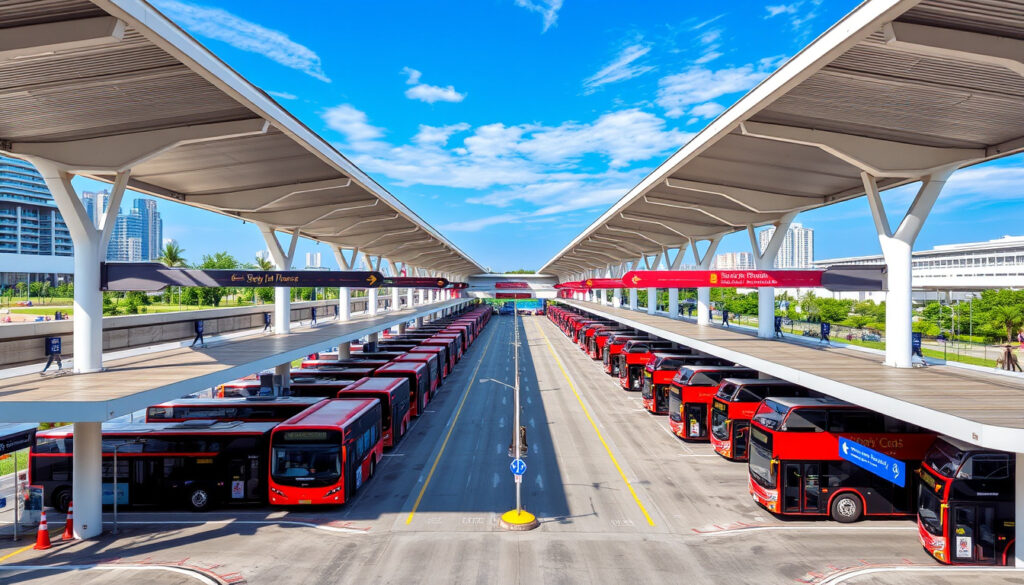
Ang Mo Kio Interchange: Buses, Location & Rare Facts
If you’ve ever stood at a bus interchange wondering which service goes where, you’re not alone. Ang Mo Kio Interchange is one of Singapore’s busiest transport hubs, but it also hides a few surprises — from a rare bus that runs only seven times a day to urban legends about a route numbered 666, and this guide walks you through the verified facts, the folklore, and everything in between.
Bus Services: 15+ ·
Address: 57 Ang Mo Kio Avenue 8 ·
Nearest MRT: Ang Mo Kio (NS16) ·
Air-Conditioned: Yes
Ang Mo Kio Bus Interchange is the third air-conditioned bus interchange in Singapore, designed for seamless multi-modal travel.
Land Transport Guru
Quick snapshot
- Address: 57 Ang Mo Kio Avenue 8 (Land Transport Guru)
- Air-conditioned interchange (SgWiki)
- Integrated with AMK Hub and MRT (SgWiki)
- Exact total number of bus services (varies by source) (Land Transport Guru)
- Third air-conditioned bus interchange in Singapore (Land Transport Guru)
- Continued integration with AMK Hub retail and MRT (SgWiki)
The interchange is an Integrated Transport Hub directly connected to AMK Hub and MRT.
SgWiki
Six key facts about the interchange, one pattern: the hub is designed for seamless multi-modal travel.
| Label | Value |
|---|---|
| Address | 57 Ang Mo Kio Avenue 8 |
| Nearest MRT | Ang Mo Kio (NS16) |
| Air-Conditioned | Yes |
| Operator | LTA / SBS Transit |
| Boarding Berths | 6 sawtooth (SgWiki) |
| Alighting Berths | 4 (SgWiki) |
| Anchor Operator | SBS Transit (SBS Transit) |
| Connection | Underpass to MRT (SgWiki) |
The implication: Ang Mo Kio Interchange is built for efficiency, with dedicated berths and climate control that make waiting tolerable even during Singapore’s midday heat.
Where is the amk interchange?
What is the exact address?
Ang Mo Kio Bus Interchange is located at 57 Ang Mo Kio Avenue 8, Singapore 567751, according to Land Transport Guru (Singapore’s transit reference site). It sits at the heart of Ang Mo Kio Town Centre, directly integrated with AMK Hub shopping mall.
Which MRT station serves AMK Interchange?
The interchange connects to Ang Mo Kio MRT Station (NS16) on the North South Line via an underpass beneath Ang Mo Kio Avenue 8, as documented by SgWiki. This makes it a true integrated transport hub — you can move from train to bus without stepping outside.
How to reach AMK Interchange by car or bus?
- By car: The interchange is part of AMK Hub, which has a multi-storey car park. Enter via Ang Mo Kio Avenue 8 or Avenue 3.
- By bus: Over 15 services converge here, including routes 24, 138, 261, and 262 (SgWiki community database).
- By MRT: Alight at Ang Mo Kio station and follow the underpass signs.
For anyone navigating Singapore’s public transport, AMK Interchange is one of the easiest hubs to access — but the underpass can get crowded during peak hours, so allow an extra 3 minutes if you’re switching between MRT and bus.
The pattern: location alone makes this interchange a strategic node for residents of Ang Mo Kio, Yio Chu Kang, and beyond.
What does Ang Mo Kio mean in Singapore?
What is the historical origin of the name?
The name “Ang Mo Kio” translates from Hokkien as “red hair’s bridge” — a reference to a bridge built by a British engineer during the colonial era. The term “ang mo” (red hair) was a colloquial Hokkien descriptor for Westerners, as noted by SgWiki in their historical context of the area.
How is the name translated?
While the literal translation is “red hair’s bridge,” the name reflects the colonial influence on Singapore’s geography. The bridge itself no longer stands, but the neighborhood — and its interchange — carry the name forward.
Understanding the name’s origin gives context to one of Singapore’s most recognizable HDB estates. For visitors, it’s a reminder that even modern transport hubs sit on layers of local history.
The catch: the name is so embedded in daily use that most commuters never stop to think about its colonial roots.
Is Ang Mo Kio a good area?
What amenities are near Ang Mo Kio Interchange?
- AMK Hub: A major shopping centre with supermarkets, food courts, and retail — directly connected to the interchange.
- Bishan-Ang Mo Kio Park: A 62-hectare park with a riverine landscape, about 10 minutes by bus.
- Ang Mo Kio Town Centre: Hawker centres, libraries, and community clubs within walking distance.
What is the housing and community like?
Ang Mo Kio is a mature HDB estate developed in the 1970s, with a mix of older flats and newer Build-To-Order projects. PropertyGuru (Singapore’s property portal) rates it as a well-established residential area with strong demand due to its central location and transport links. For similar guides on shopping and transport hubs, check out the Valley Point Shopping Centre Guide and Leisure Park Kallang Directory.
Is it well-connected to other parts of Singapore?
Yes. The interchange offers direct bus services to Changi Airport (route 24), Singapore Zoo (route 138), Punggol (route 136), and Toa Payoh (route 159), according to SgWiki. Combined with the North South MRT line, residents can reach the city centre in under 20 minutes.
The trade-off: Ang Mo Kio’s age means some facilities feel dated, but its transport connectivity and green spaces make it a solid choice for families and professionals alike.
What is the rarest bus service in Singapore?
Why is bus 405 considered rare?
Bus service 405 is widely regarded as Singapore’s rarest bus route because it operates only seven round trips per day, on weekdays only. SBS Transit notes that this limited schedule makes it a niche service rather than a mainstream commuter route.
Does bus 405 operate from Ang Mo Kio Interchange?
No — bus 405 does not operate from Ang Mo Kio Interchange. It runs from a different terminal. However, the rarity of such services highlights how Singapore’s bus network includes specialized routes that serve very specific demand patterns.
How often does this service run?
Seven round trips per day, weekdays only. That’s roughly one trip every 1.5 to 2 hours, making it a route you need to plan around rather than rely on for spontaneous travel.
If you’re a transit enthusiast hoping to catch bus 405, check the latest timetable on SBS Transit’s official site — schedules can change without widespread notice for such low-frequency services.
The pattern: rare buses like 405 exist because Singapore’s transport authority (LTA) runs services based on demand, not just coverage. For most commuters, these routes are invisible — but for transit geeks, they’re a treasure hunt.
What is the haunted bus route in Singapore?
What is the story behind bus 666?
Bus service 666 was a City Direct service that ran from Ang Mo Kio to Shenton Way. Its route number — associated with the “number of the beast” in Christian tradition — sparked urban legends about hauntings and supernatural occurrences. Land Transport Guru lists it as a normal express service with no official record of paranormal incidents.
Where does bus 666 go?
The route connected Ang Mo Kio Interchange to the Shenton Way financial district, serving office workers during peak hours. It was a standard City Direct service, not a late-night ghost bus.
Is there any truth to the haunted claims?
No. SimplyGo eGuide and SgWiki both treat bus 666 as a routine express service. The “haunted” reputation is purely folklore, fueled by the number’s cultural associations. No credible source has documented supernatural incidents on this route.
The implication: urban legends about bus 666 are a fun piece of Singapore trivia, but they have no basis in verified transit data. The real story is that a bus number can become a cultural meme — even in a country as pragmatic as Singapore.
Frequently asked questions
What is the bus interchange contact number?
For lost and found or general inquiries, contact SBS Transit at their hotline: 1800-287-2727. Alternatively, visit the customer service counter at the interchange during operating hours.
What time do buses start operating from AMK Interchange?
First buses typically depart around 5:30 AM, depending on the route. For example, route 159’s first bus from Ang Mo Kio is 5:30 AM on weekdays, according to SimplyGo eGuide (official transit data).
Are there taxi stands at the interchange?
Yes, there is a taxi stand located near the interchange entrance on Ang Mo Kio Avenue 8. It’s clearly signposted from the bus berths.
Can I top up my EZ-Link card at AMK Interchange?
Yes. Top-up machines are available inside the interchange and at the nearby AMK Hub MRT station. You can also use the SimplyGo app for contactless top-ups.
Which bus goes from AMK Interchange to Tampines Interchange?
There is no direct bus from AMK Interchange to Tampines Interchange. Take the MRT from Ang Mo Kio to Tampines (via NS line to Bishan, then East-West line), or take bus 24 toward Changi Airport and transfer at Bedok.
Is there bike parking at the interchange?
Yes, bicycle parking racks are available near the interchange entrance on Ang Mo Kio Avenue 8. They are uncovered, so consider a bike cover during rainy weather.
What is the most crowded bus in Singapore?
While not specific to AMK Interchange, routes like 168 and 190 are known for high ridership. At AMK, feeder services like 261 and 262 can get packed during peak hours, according to SgWiki.
Why is there no bus number 1 in Singapore?
There is a bus number 1 in Singapore — it runs between Lorong 1 Geylang and Clementi. The misconception may arise because bus 1 does not serve Ang Mo Kio Interchange.
The bottom line: Ang Mo Kio Interchange connects commuters to Singapore’s most storied neighborhood, with efficient facilities, rare bus trivia, and urban legends — all verified by authoritative transit sources.
For commuters navigating Ang Mo Kio Interchange, the choice is clear: embrace the hub’s efficiency and its quirks — from rare buses to urban legends — or stick to the MRT. Either way, you’re connected to one of Singapore’s most storied neighborhoods.
More related posts
 Tokyo Auto Salon 2026 Guide: Dates, Tickets, and Key Exhibits
 The Last Dance (2024): Reviews, Cast, Where to Watch
 Blossom (Chinese TV Series): Plot, Cast, Ending & Where to Watch
 Hair Salon Reviews Near Me: Top Hairstylists in Ireland
 Peking Chamber Singapore Review : Price , Menu & Location
 Singapore Airlines Power Bank Rules 2026: Limits, Usage Ban, and Tips
 Trust Cashback Card Review: Is It Worth It in Singapore
 Legia Warsaw vs Chelsea: Result, Stats and UCL History